A refinery can look like an endless maze of towers, vessels, reactors, furnaces, compressors, exchangers, pumps, valves, and piping. But once you understand what the individual process units do—and how one unit feeds the next—the refinery begins to make sense.
That is the purpose of the NÆXON Refinery Unit Course.
This course breaks refinery processing into individual lessons designed to help industrial workers understand what enters a unit, what happens inside it, what equipment makes the process possible, what leaves the unit, and where those products go next.
The goal is not simply to memorize refinery terminology. It is to build a working mental picture of how a modern refinery operates.
Built for the People Who Work in Refineries
This course was created for the people who build, operate, maintain, inspect, repair, and support these facilities.
Pipefitters may spend weeks installing or replacing piping around a process unit without ever being shown what that unit actually does. Welders can make critical welds on process lines without knowing what is moving through them. Millwrights rebuild pumps and compressors that are essential to processes they may know only by an equipment number.
The same applies to boilermakers, electricians, instrumentation technicians, operators, riggers, scaffold builders, ironworkers, insulators, helpers, apprentices, supervisors, and other refinery workers.
Understanding the process gives the equipment around you context.
A tower stops being simply a tower. A reactor has a purpose. A compressor belongs to a process. A pipe is carrying a stream from somewhere—and that stream has somewhere else to go.
Start Where Refining Begins
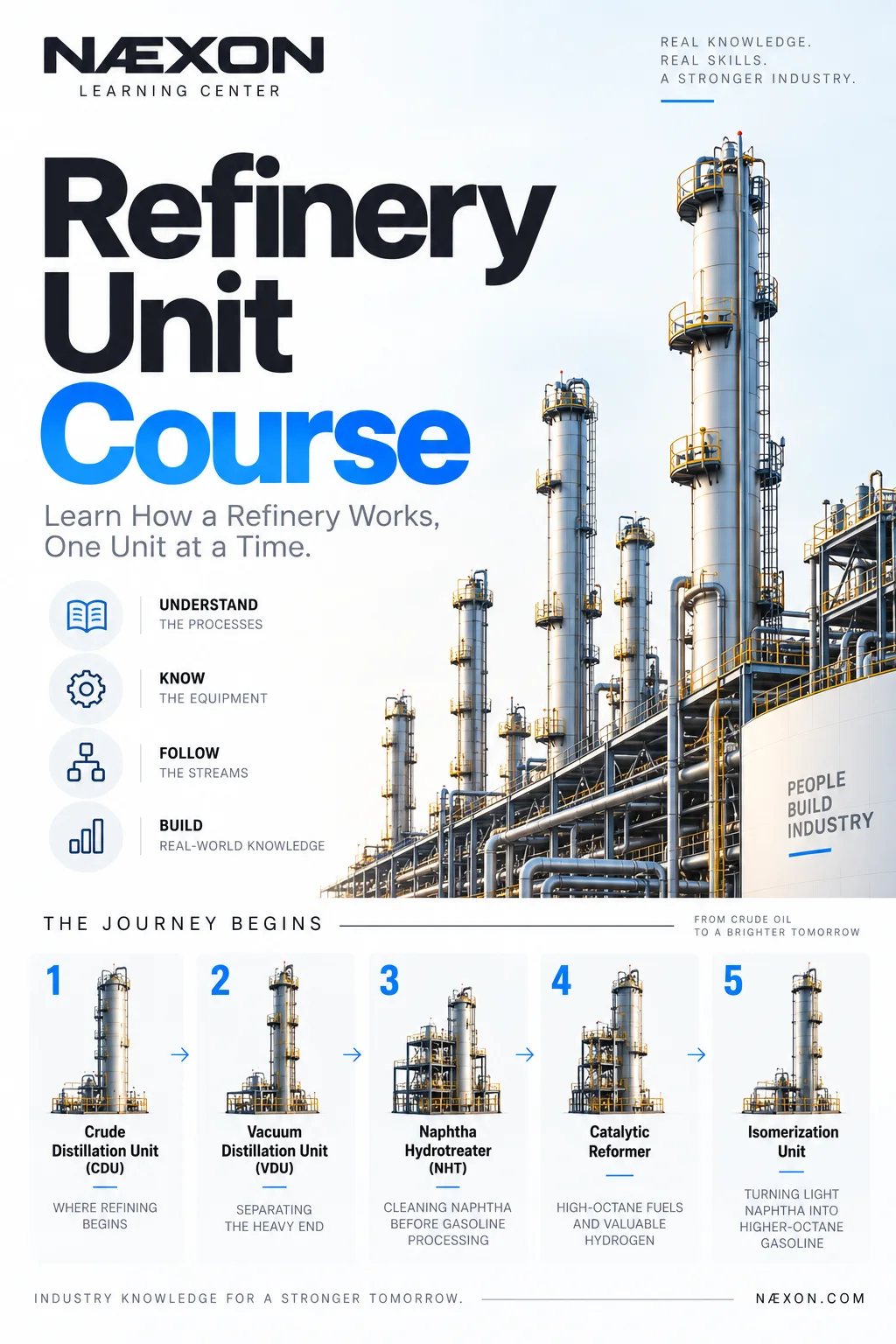
The course begins with the Crude Distillation Unit (CDU): Where Refining Begins.
This is the logical starting point because the CDU performs the refinery’s first major separation of crude oil. Rather than immediately converting crude into finished products, the unit separates it into different boiling ranges that can be routed to additional processing.
From there, continue to the Vacuum Distillation Unit (VDU): Separating the Heavy End. The VDU takes heavy material from atmospheric distillation and performs additional separation under reduced pressure, allowing extremely heavy hydrocarbons to be processed without exposing them to unnecessarily severe temperatures.
The third lesson moves into treating with the Naphtha Hydrotreater (NHT): Cleaning Naphtha Before Gasoline Processing. Here, the course begins showing why refinery units cannot be understood in isolation. Naphtha must be properly treated before it can safely and effectively enter certain downstream catalytic processes.
That leads directly into Refinery Unit #4 — Catalytic Reformer, where hydrotreated naphtha is transformed into valuable high-octane reformate while also producing hydrogen that can support other refinery processes.
Then continue into the Isomerization Unit: How Refineries Turn Light Naphtha Into Higher-Octane Gasoline to see another way refiners improve gasoline components by changing molecular structure rather than simply separating hydrocarbons.
These first five lessons establish the foundation for everything that follows.
Follow the Hydrocarbons Through the Refinery
As the course progresses, the refinery becomes increasingly interconnected.
You will move into processes involving alkylation, fluid catalytic cracking, hydrocracking, hydrotreating, delayed coking, hydrogen production, amine treating, sour-water processing, sulfur recovery, gas recovery, LPG fractionation, light-ends processing, heavy-residue conversion, and aromatics processing.
Instead of treating each process as an isolated definition, the course focuses on the relationships between them.
A simplified refinery path might look like:
Crude Oil → Separation → Treating → Conversion → Recovery → Fractionation → Blending or Further Processing
But there are many branches within that path.
Heavy material from one process may become feed for a cracking unit. Hydrogen produced or supplied elsewhere can support hydrotreating and hydrocracking. Sour gases can move into amine treating and ultimately sulfur recovery. FCC gases can be separated into valuable LPG and olefin streams. Aromatic hydrocarbons can be recovered and processed into valuable petrochemical feedstocks.
Understanding those connections is where refinery knowledge becomes much more useful.
Learn the Equipment Along With the Process
Every unit also introduces equipment workers will repeatedly encounter throughout a refinery.
Distillation and fractionation columns separate mixtures. Reactors create chemical changes. Fired heaters add process heat. Heat exchangers transfer energy between streams. Pumps move liquids. Compressors move gases. Drums separate vapor and liquid. Reboilers and condensers support fractionation. Control valves regulate operating conditions. Relief systems protect equipment during abnormal conditions.
The course connects that equipment to its purpose.
For someone working in the trades, that can completely change the way a refinery looks.
Instead of seeing disconnected pieces of equipment, you begin seeing a process system.
Four Questions Can Teach You a Refinery
As you work through each lesson, keep four questions in mind:
- What enters this unit?
- What happens to the material inside the unit?
- What leaves the unit?
- Where does it go next?
If you can answer those questions, you already understand the foundation of that process.
Repeat that exercise across the refinery and the individual units begin connecting into a much larger picture.
Process Awareness Matters in the Field
This course does not replace engineering documents, operating procedures, craft training, permits, process-safety requirements, site procedures, or job-specific instruction.
Its purpose is process awareness.
If you are working around an FCC, understanding what the FCC does gives meaning to the equipment surrounding you.
If you are repairing piping around an amine unit, understanding why acid gases are being removed provides context for the system and its hazards.
If you are working around a hydrotreater, understanding hydrogen service, feed treatment, reactors, separators, and downstream processing helps explain why the unit is configured the way it is.
The more you understand the process, the more intelligently you can look at the equipment around you.
One Unit at a Time
Nobody needs to understand an entire refinery in one day.
Start with the crude unit.
Learn what enters it and what leaves.
Then follow those streams.
Learn the next unit.
Then the next.
Eventually, the pipe racks, towers, reactors, exchangers, compressors, pumps, and vessels stop looking like unrelated equipment.
You begin seeing the refinery as a connected system.
That is what the NÆXON Refinery Unit Course is built to teach.
Start with Unit #1. Follow the process. Build the knowledge.
Real knowledge. Real skills. A stronger industry.