Spend enough time in a fabrication shop, refinery, power plant, pipeline spread or turnaround and you’ll eventually notice something about welding caps:
The bill is almost never where the bill of a normal hat would be.
It’s turned sideways.
Usually pulled down over one ear.
To somebody outside the trades, it might look like nothing more than style. And yes, after generations of welders wearing them this way, the sideways welding cap has absolutely become part of blue-collar culture.
But there is a practical reason behind it.
The bill can be positioned over the exposed ear to provide another fabric barrier between the worker and sparks, slag and hot debris.
That little bill actually has a job.
The Functional Way to Wear a Welding Cap
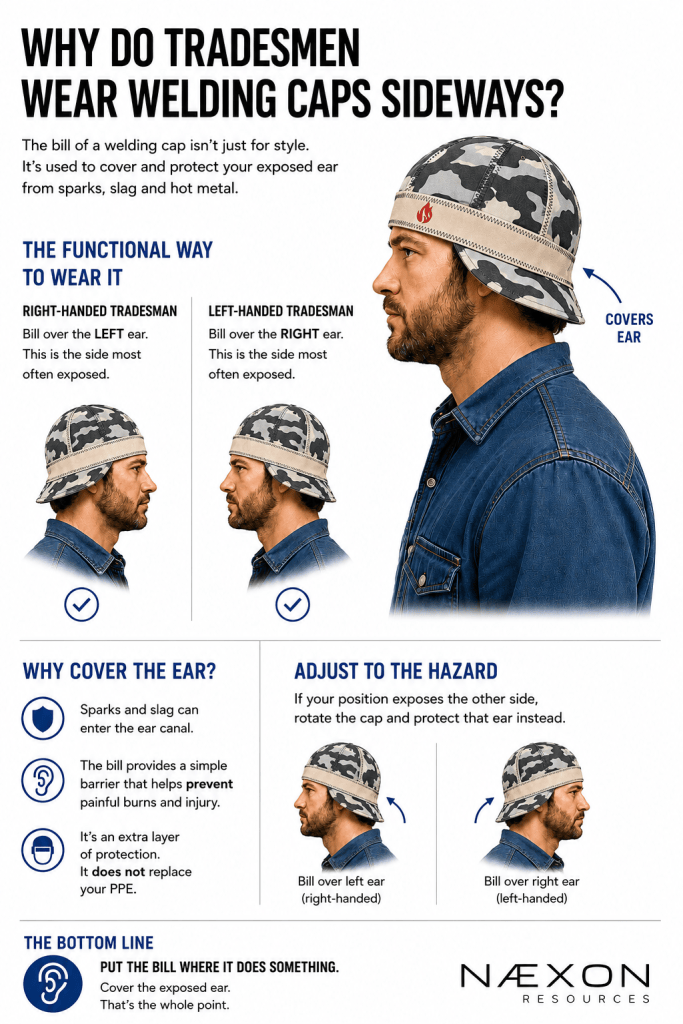
There isn’t one position that works for every welding situation because your body position and the direction of the sparks change.
But there’s a simple starting point we like:
Right-handed tradesman → bill over the LEFT ear.
Left-handed tradesman → bill over the RIGHT ear.
For a right-handed welder, positioning the bill over the left ear can help cover the side that is often exposed while working.
For a left-handed welder, reverse it.
Left hand working? Bill over the right ear.
The important part isn’t following a fashion rule.
It’s understanding what the bill is there to do.
Cover the Ear
This is the part that matters.
Don’t just turn the welding cap sideways and leave the bill sticking straight out because that’s how everyone else wears it.
Pull the bill down so it actually covers the exposed ear.
Anyone who has welded overhead knows that sparks have an incredible ability to find the smallest unprotected area on your body.
Down the collar.
Inside the sleeve.
Between the glove and cuff.
And, unfortunately, toward the ear.
A welding cap doesn’t eliminate that hazard and it doesn’t replace required PPE, but positioning the bill correctly gives you another layer of fabric coverage.
That is functionality.
Why Right-Handed Tradesmen Often Put the Bill Over the Left Ear
Picture a right-handed welder working around pipe.
The torch or stinger is controlled primarily with the right hand. The worker adjusts his shoulders, neck and head to maintain a clear view of the puddle.
Depending on the welding position, that can leave the opposite side of the head exposed.
So the cap gets rotated.
Bill to the left. Pull it down. Cover the ear.
A left-handed worker can do the opposite.
But don’t treat this as an absolute rule. Welding positions change constantly.
Which brings us to the rule that matters more than handedness:
Put the Bill Where the Hazard Is
Sometimes the right-handed/left-ear setup won’t make sense.
Maybe you’re underneath the pipe.
Maybe you’re welding overhead.
Maybe you’re squeezed between piping.
Maybe you’re working against a wall.
Maybe you’re reaching around a joint from an awkward position.
If sparks are coming toward the other side of your head, rotate the cap.
That’s one of the advantages of a traditional welding cap.
The bill is short and soft enough that the worker can change its position depending on what he’s doing.
Left.
Right.
Back.
Wherever the additional coverage is useful.
The job determines the position.
Why Not Wear the Bill Forward Like a Baseball Cap?
Because a welding cap isn’t really designed to function like a baseball cap.
A baseball-cap bill is primarily positioned in front of the face to shade the eyes.
A welding cap lives in a completely different environment.
It may be worn underneath a welding hood. The wearer may be crawling underneath pipe, welding overhead, fitting, grinding or constantly changing positions.
A long rigid bill would become annoying very quickly.
The short welding-cap bill can be moved around the head without creating the same interference.
That’s why the sideways position makes so much sense.
The Welding Hood Changes Everything
A welding cap also has to work underneath other equipment.
Drop a welding hood over your head and suddenly the way your cap fits matters a lot more.
The hood moves.
You flip it up.
Drop it down.
Move your head.
Lean sideways.
Look underneath something.
A poorly fitting cap can shift every time you move the hood.
That’s one reason Næxon uses a deeper crown on its welding caps. A deeper crown allows the cap to sit farther down around the sides and back of the head for workers who prefer that type of fit.
We explain the construction in more detail in Why Deep-Crown Welding Caps Fit Different — And Why It Matters.
Fit isn’t just about comfort.
It affects how easily you can position the cap where you want it.
Why Welding Caps Have Deep Crowns
The bill isn’t the only part providing coverage.
The crown matters too.
A deeper welding cap can extend farther down around the sides and back of the head compared with a shallow cap.
That becomes useful when you’re wearing the cap underneath a hood and want more fabric around your head.
Næxon welding caps use an eight-panel, deep-crown construction designed around that type of fit.
The concept is simple:
The cap should sit on your head—not balance on top of it.
The Næxon Smoke Welding Cap was designed specifically around this idea, using a deep crown, eight-panel construction and double stitching for everyday industrial use.
The Sideways Cap Became Part of Trades Culture
Function eventually became tradition.
A welder turned the bill because it worked.
Another welder did the same thing.
Then another.
Eventually the sideways welding cap became one of the most recognizable looks in industrial work.
Today you’ll see welding caps on more than welders.
Pipefitters wear them.
Boilermakers wear them.
Millwrights wear them.
Ironworkers wear them.
Helpers wear them.
Sometimes even the foreman who hasn’t struck an arc in fifteen years is walking around wearing one.
The welding cap escaped the welding booth a long time ago.
That’s part of what we explored in What Your Welding Cap Says About What Kind of Hand You Are.
The sideways bill became style.
But the style came from the work.
Welding Caps Aren’t Supposed to Stay Clean
A real working welding cap lives a rough life.
Sweat.
Grinding dust.
Smoke.
Sparks.
Wash.
Repeat.
It gets folded and shoved into a lunchbox.
Thrown on the dashboard.
Stuffed into a gang box.
Worn underneath a hood for twelve hours.
Then washed and put back into rotation.
That’s why construction matters.
Næxon’s Dragup Edition Welding Cap was designed around the same reality—deep crown, eight-panel construction, double stitching and a design intended for workers moving from project to project.
A welding cap is workwear.
It should be treated like workwear.
A Welding Cap Does Not Replace PPE
This point needs to be clear.
A welding cap is an additional fabric barrier—not a replacement for required protective equipment.
Your welding hood, eye and face protection, FR clothing, gloves, hearing protection where required and whatever PPE is specified for the task still matter.
The cap simply helps cover areas around the head and can be positioned to provide additional coverage where it is useful.
Think of it as another piece of the system.
Not the entire system.
The same philosophy applies to good industrial gear in general. The best equipment often comes from workers recognizing small problems and finding practical ways to solve them, something we discuss in Built by the Trades: Why the Best Jobsite Gear Often Starts With a Worker Saying, “I Can Make That Better”.
So Which Way Should You Wear Your Welding Cap?
Start with the simple setup:
Right-handed → bill over the left ear.
Left-handed → bill over the right ear.
Then look at the work you’re actually doing.
If your welding position exposes the opposite side, rotate the cap.
If sparks are coming from somewhere else, reposition it.
Don’t wear it sideways simply because that’s what welders do.
Put the bill where it does something.
Pull it down.
Cover the exposed ear.
That’s the functionality behind one of the most recognizable pieces of workwear in the trades.
The sideways welding cap may have become part of the culture.
But it started with the work.