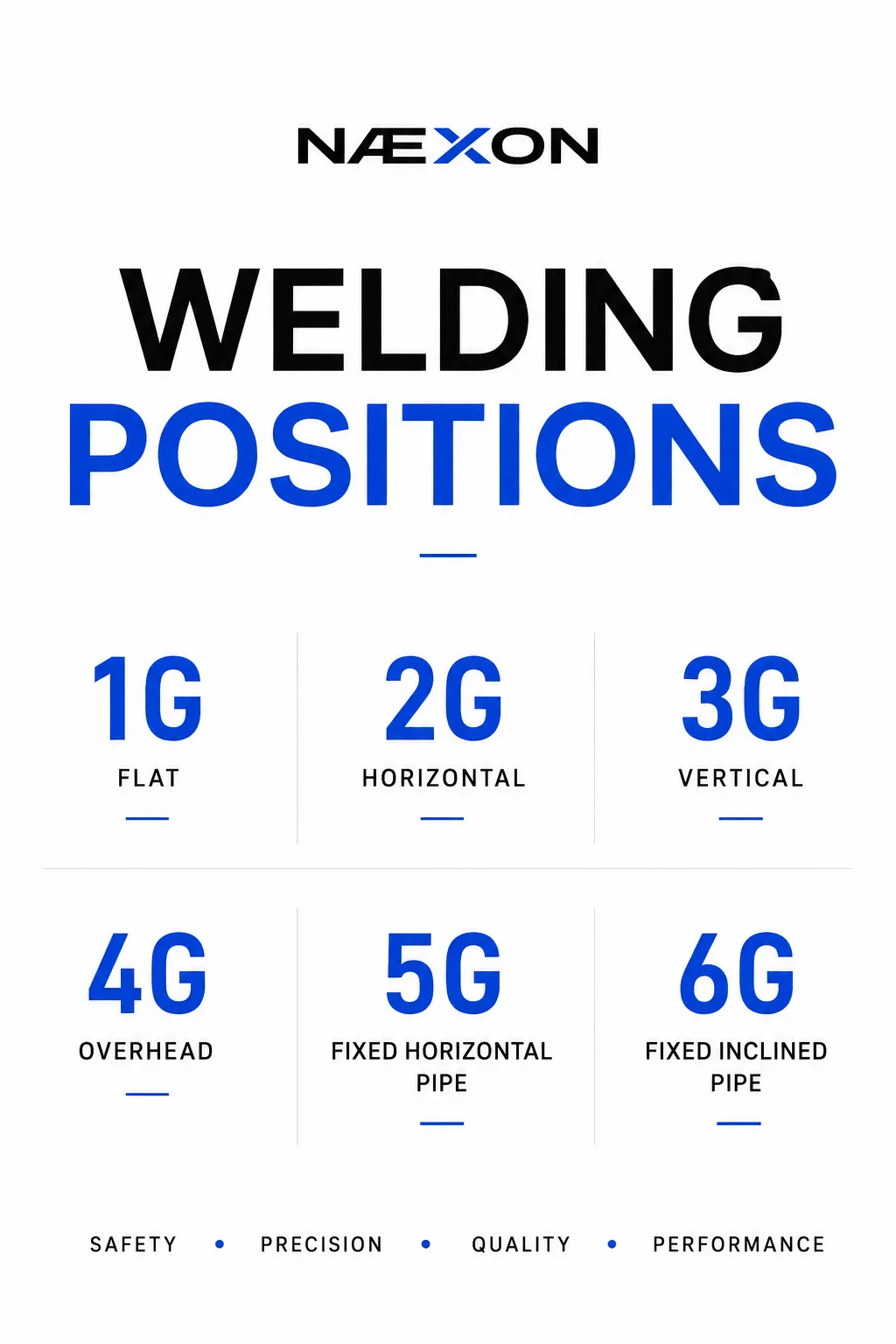
Næxon Learning Center | Welding Fundamentals
When a welder says they’re practicing 2G, 5G, or 6G, those numbers aren’t describing the welding process. They’re describing the position of the joint and how the weld is performed.
Understanding welding positions is fundamental for anyone entering structural, pipe, refinery, power plant, pipeline, fabrication, or industrial welding.
The basic system is easy to remember:
The number identifies the position.
G means groove weld.
So 6G means a groove weld performed in the 6G position.
The important part is understanding what each position physically looks like and what it requires from the welder.
1G — Flat Groove Position
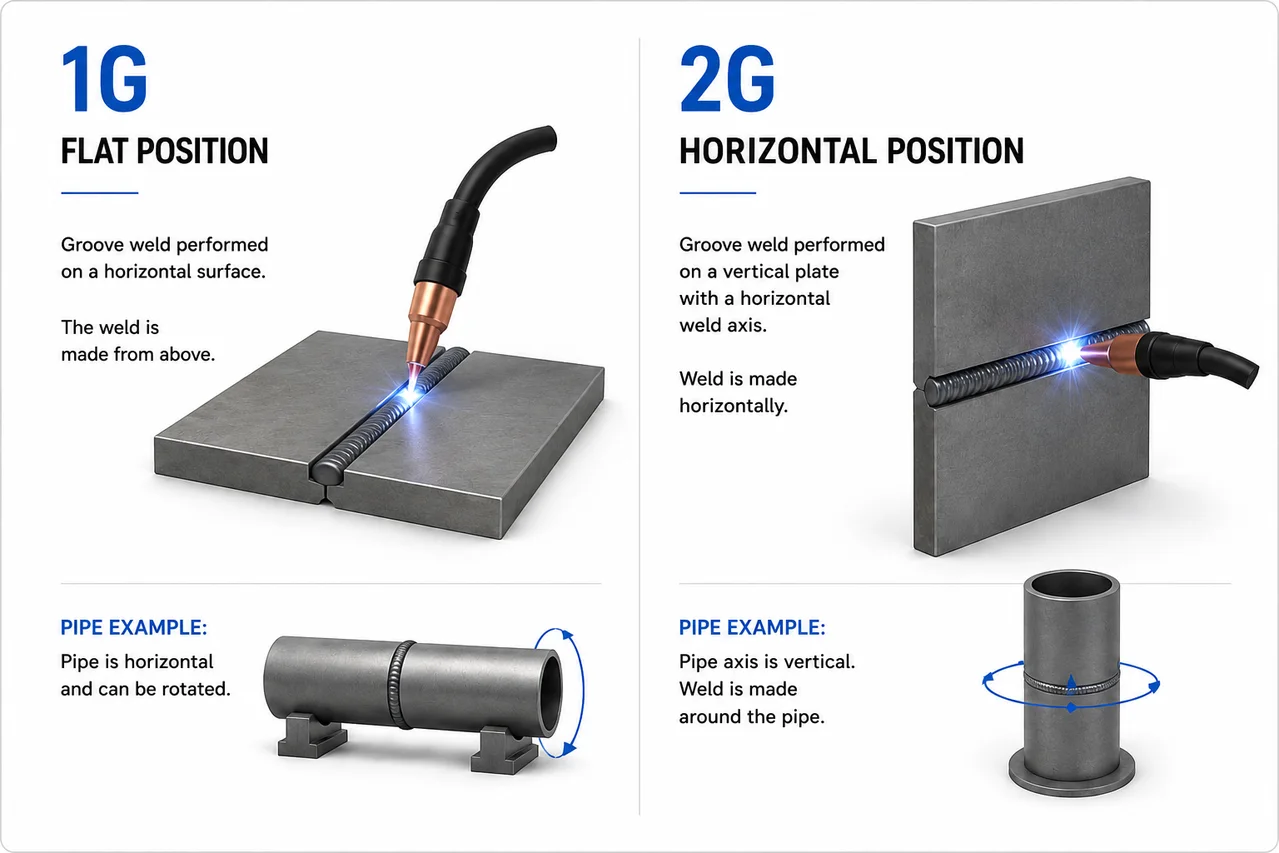
1G vs. 2G welding positions: 1G places the groove weld in the flat position, while 2G places the groove horizontally on a vertical surface. For pipe, 1G uses a horizontal pipe that can rotate, while 2G uses a vertical pipe axis with the weld made around its circumference.
1G is the flat position.
For plate, the joint is positioned so the welder deposits the groove weld from above.
Gravity generally helps keep the molten puddle in the joint, making this one of the easiest positions for learning puddle control.
For pipe, 1G is commonly associated with the pipe positioned horizontally while being rotated during welding. The welder can remain in approximately the same working position while the pipe turns.
Think:
1G = flat and/or rotated into the favorable welding position.
This is common in fabrication environments where the workpiece can be manipulated.
2G — Horizontal Groove Position
In 2G plate, the plate is positioned vertically while the groove runs horizontally.
The welder travels horizontally across the joint.
Gravity now pulls the molten puddle downward, so controlling bead placement becomes more challenging than in the flat position.
For 2G pipe, the pipe axis is vertical and the pipe remains fixed. The weld runs around the pipe in a horizontal plane.
Think of a pipe standing upright while you weld around its circumference.
2G pipe = vertical pipe axis, fixed pipe.
3G — Vertical Groove Position
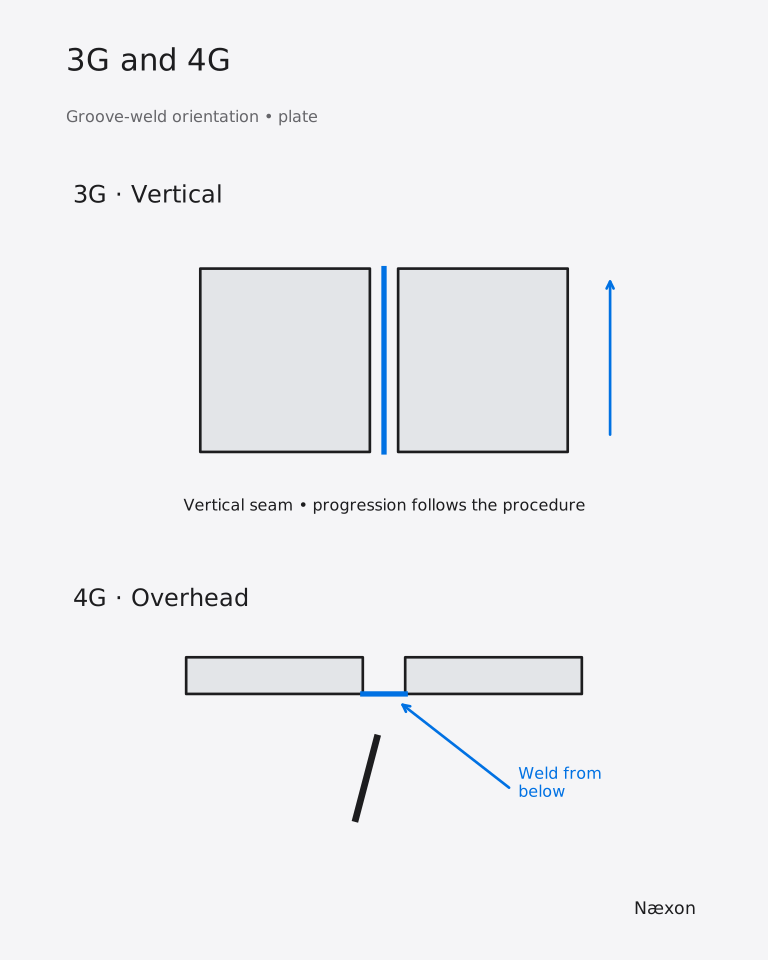
3G applies to plate groove welding in the vertical position.
The plate is vertical and the weld progresses vertically along the joint.
Depending on the applicable procedure, process, electrode, and qualification requirements, welding may progress:
Vertical uphill
or
Vertical downhill.
These aren’t interchangeable simply because they’re both 3G. The required progression is an important part of the welding procedure and qualification.
Vertical welding requires much greater puddle control because gravity is constantly acting on the molten metal.
4G — Overhead Groove Position
4G is the overhead groove position for plate.
The joint is above the welder, and welding is performed from underneath.
Now gravity is working directly against the weld puddle.
The welder must maintain appropriate arc length, electrode or gun angle, travel speed, and puddle size while working overhead.
This is where poor puddle control becomes obvious very quickly.
Think:
4G = plate overhead.
Why Pipe Uses Different Positions
Pipe creates a different challenge because the joint wraps around the entire circumference.
On fixed horizontal pipe, for example, the welder doesn’t stay in one simple position.
As you move around the pipe, your relationship to gravity continuously changes.
You may effectively transition through different orientations during the same weld.
That’s why fixed-position pipe welding can demand considerably more positional control than a simple flat weld.
5G — Fixed Horizontal Pipe

In the 5G position, the pipe’s axis is horizontal and the pipe remains fixed.
It doesn’t rotate while you’re welding.
Imagine a pipe running horizontally through a pipe rack.
You have to weld around its circumference.
At the top, you’re working in one orientation. As you move down the side, the puddle behaves differently. At the bottom, you’re welding overhead.
The pipe stays still.
You move around the pipe.
That’s the easiest way to remember 5G.
5G = horizontal pipe, fixed position.
This is extremely relevant to industrial pipe welding because installed piping often cannot simply be rolled into whatever position is easiest for the welder.
6G — Fixed Pipe at Approximately 45 Degrees
The 6G position is one of the best-known pipe welding qualification positions.
The pipe is fixed with its axis inclined, commonly around 45 degrees, and it cannot be rotated during welding.
This creates a demanding combination of welding positions as the welder travels around the joint.
Your body position changes.
Your electrode or torch angle changes.
Gravity’s effect on the puddle changes.
Your visibility changes.
Your access changes.
But the weld still has to remain consistent around the entire circumference.
Think:
6G = fixed pipe on an angle.
Why 6G Is So Challenging
Look at a fixed pipe positioned at roughly 45 degrees.
There isn’t one comfortable welding position around the entire joint.
As you travel around the circumference, you’re continually transitioning between different orientations while maintaining control of the root, hot pass, fill passes, and cap as required.
The welder has to understand the puddle rather than relying on one memorized hand position.
That’s one reason 6G is commonly associated with advanced pipe-welding qualification and training.
The Simple Position Guide
Here’s the easiest way to keep the major groove positions straight:
1G — Flat / favorable groove position
2G — Horizontal groove
3G — Vertical groove
4G — Overhead groove
5G — Fixed horizontal pipe
6G — Fixed pipe inclined approximately 45°
For pipe:
1G = pipe can rotate
2G = pipe axis vertical
5G = pipe axis horizontal and fixed
6G = pipe axis inclined and fixed
Those four relationships are worth memorizing.
Fixed vs. Rotated Pipe
This distinction is extremely important.
If the pipe can rotate, the welder can often keep the active portion of the joint in a favorable welding position.
When the pipe is fixed, the welder has to adapt to the joint.
That changes everything.
Imagine welding a spool sitting on turning rolls in a fabrication shop.
Now imagine welding a spool already installed between two pieces of equipment in a refinery.
Same basic pipe joint.
Completely different welding challenge.
Welding Position Doesn’t Tell You Everything
Knowing that a weld is “6G” doesn’t tell you the entire welding procedure.
You still need to know the applicable WPS requirements, including factors such as:
Welding process
Base material
Filler metal or electrode
Diameter and wall thickness
Joint design
Root opening
Root face
Bevel or groove angle
Preheat and interpass requirements
Electrical parameters
Progression
and other applicable variables.
Position is only one part of the complete welding requirement.
Don’t Confuse Position With Progression
This is especially important with vertical welding.
Position describes how the joint is oriented.
Progression describes the direction the weld travels.
For example, a vertical weld may require upward progression under one procedure while another application may use downward progression.
Never assume the direction simply because you know the position number.
Follow the applicable WPS.
Why Welding Qualifications Use Positions
A welding qualification isn’t simply testing whether someone can make an attractive bead.
The test demonstrates the welder’s ability to deposit an acceptable weld under specified conditions.
Different test positions can qualify a welder for different ranges of production welding depending on the governing code, standard, process, joint, and qualification variables.
This is why you shouldn’t assume:
“I passed 6G, so I’m automatically qualified for everything.”
Qualification ranges depend on the applicable code and procedure.
Common Mistakes
One common mistake is thinking G means gas.
It doesn’t.
In these designations:
G = Groove
Another mistake is confusing 5G and 6G.
Remember:
5G → fixed horizontal pipe
6G → fixed inclined pipe
Welders also sometimes confuse welding position with travel direction or assume that every qualification follows identical rules.
Always check the applicable procedure and qualification requirements.
Field Rule
Memorize this:
1G — FLAT
2G — HORIZONTAL
3G — VERTICAL
4G — OVERHEAD
Then for pipe:
5G — HORIZONTAL + FIXED
6G — ANGLED + FIXED
Once you can visualize the joint instead of merely memorizing the numbers, welding-position terminology becomes much easier.
Knowledge Check
1. What does the G represent in 6G?
Groove weld.
2. What makes 5G pipe different from 1G pipe?
In 5G, the horizontal pipe is fixed. In 1G pipe welding, the pipe can be rotated to maintain a favorable welding position.
3. What orientation is associated with 6G pipe?
The pipe is fixed with its axis inclined, commonly around 45 degrees.
4. Which plate position is overhead?
4G.
5. Which plate position is vertical?
3G.
6. Does passing a particular welding position automatically qualify a welder for every possible weld?
No. Qualification ranges depend on the applicable code, procedure, process, and other essential variables.
Practical Exercise
Take six simple drawings and label them 1G through 6G.
For 1G, draw a flat groove joint.
For 2G, draw a vertical plate with a horizontal groove.
For 3G, draw a vertical plate with the weld traveling vertically.
For 4G, place the groove overhead.
For 5G, draw a horizontal pipe and mark:
FIXED — DO NOT ROTATE
For 6G, draw the pipe approximately 45 degrees and mark:
FIXED — DO NOT ROTATE
Underneath the six diagrams write:
DON’T JUST MEMORIZE THE NUMBER. VISUALIZE THE POSITION.
Once you can look at a joint and immediately recognize its welding position, you’ve built a foundation that carries into welding procedures, qualification testing, fabrication, and field welding.