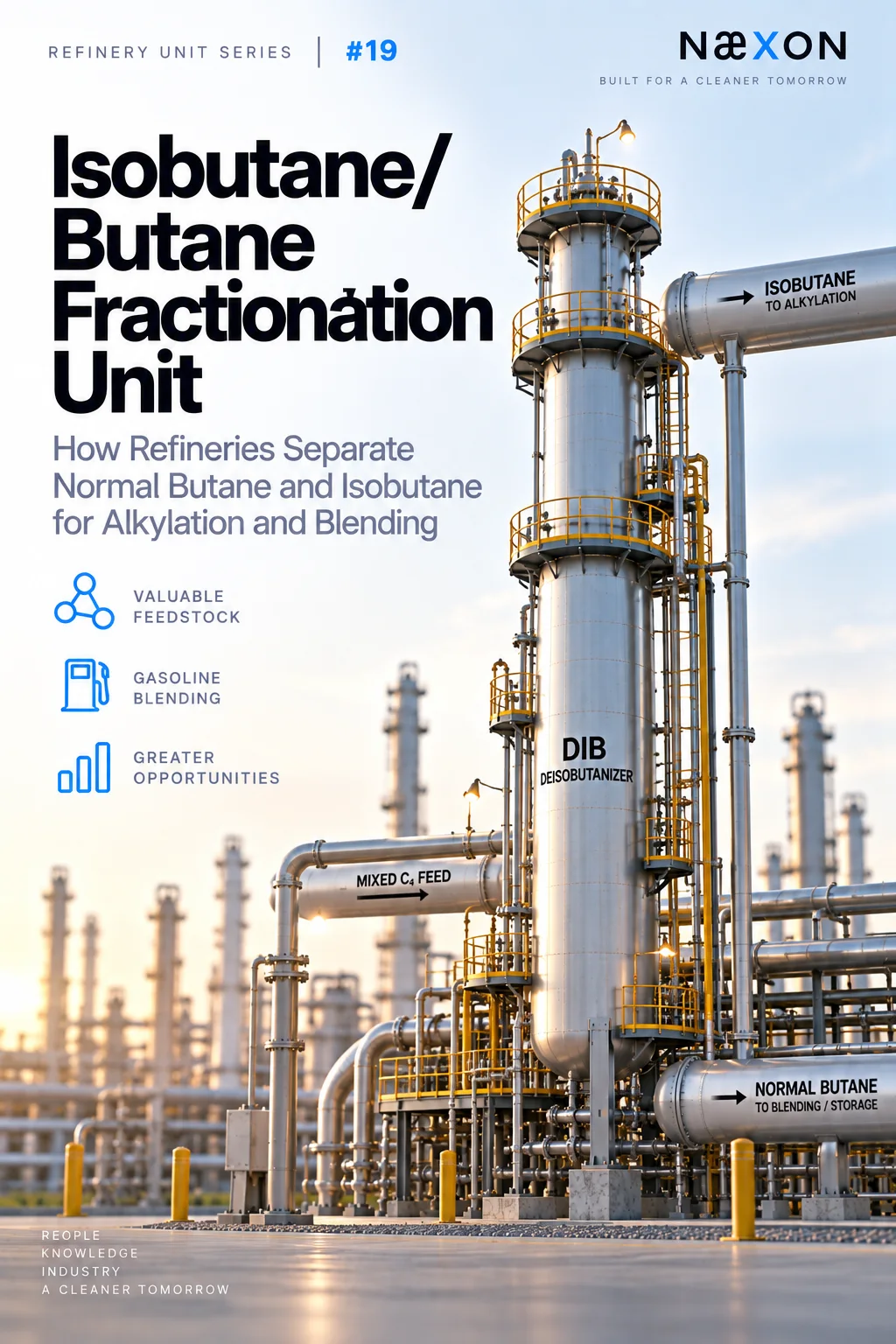
After light hydrocarbons are recovered and separated in the refinery’s Gas Recovery and LPG Fractionation systems, the refinery can still have another important separation to make.
A C₄ stream may contain both normal butane (n-butane) and isobutane (i-butane).
They contain the same number of carbon atoms, but their molecular structures are different. That difference matters because the refinery can use them for very different purposes.
Isobutane is an important feedstock for the Alkylation Unit, where it reacts with light olefins to produce high-octane alkylate.
Normal butane, meanwhile, can be used in gasoline blending, LPG production, converted to isobutane where appropriate, or routed elsewhere depending on refinery configuration and economics.
Separating these two C₄ hydrocarbons is the job of the Isobutane/Butane Fractionation Unit, often centered around a fractionation column commonly called a deisobutanizer, or DIB.
The simplified process is:
Mixed C₄ Feed → Deisobutanizer → Isobutane-Rich Overhead + Normal-Butane-Rich Bottoms
The concept sounds simple. The actual separation is challenging because normal butane and isobutane have relatively close boiling points.
Where Does the C₄ Feed Come From?
C₄ hydrocarbons can originate from several refinery processes.
One important source is the Gas Recovery & LPG Fractionation Unit covered in Unit #17.
That system separates refinery light hydrocarbons into major carbon-number groups such as:
C₂ and lighter
C₃
C₄
C₅+
But separating a C₄ stream from C₅+ material does not necessarily mean all C₄ molecules are identical.
The C₄ fraction can contain different hydrocarbons, including:
- Normal butane
- Isobutane
- Butenes
- Other C₄ components depending on the source
Additional processing may therefore be required.
Normal Butane vs. Isobutane
Normal butane and isobutane have the same molecular formula:
C₄H₁₀
But their molecular structures are different.
Normal butane has a relatively straight carbon chain.
Isobutane has a branched structure.
This makes them structural isomers.
That structural difference changes some of their physical and chemical behavior and, most importantly for refinery operations, makes them useful for different processing purposes.
Why Is Isobutane So Important?
Isobutane is especially valuable because it is a major reactant in the refinery’s Alkylation Unit.
In alkylation, isobutane reacts with light olefins such as butylenes and sometimes propylene.
The result is alkylate.
Alkylate is a highly valuable gasoline blending component because it generally provides:
High octane
Low sulfur
Low olefin content
and desirable gasoline-blending characteristics.
That creates an important refinery pathway:
C₄ Recovery → Isobutane Separation → Alkylation → Alkylate → Gasoline Blending
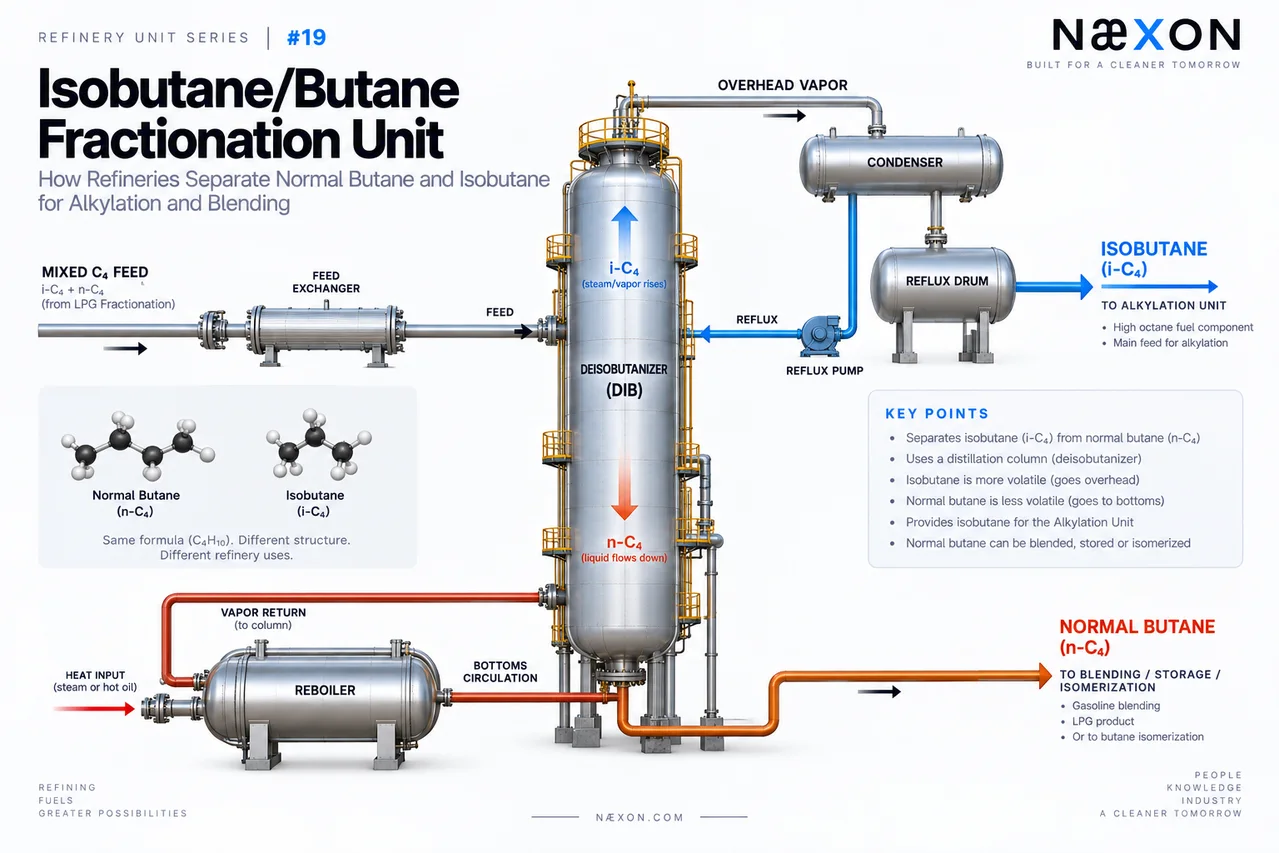
Figure: Simplified process flow of an Isobutane/Butane Fractionation Unit, showing mixed C₄ feed entering the deisobutanizer (DIB), where isobutane is recovered overhead for alkylation while normal butane leaves the bottom for blending, storage, or further processing.
The Alkylation Unit therefore depends heavily on having the correct hydrocarbon feed available.
What Is a Deisobutanizer?
The deisobutanizer, commonly abbreviated DIB, is a fractionation column designed to separate isobutane from normal butane and other heavier C₄ material.
The simplified separation is:
Isobutane-Rich Stream → Overhead
Normal-Butane-Rich Stream → Bottoms
This happens because isobutane is slightly more volatile than normal butane.
But the boiling points are close.
That means the separation requires careful fractionation.
Why Is This Separation Difficult?
Some refinery fractionation duties involve components with large differences in boiling point.
Those separations can be relatively straightforward.
The DIB is different.
Normal butane and isobutane have boiling points separated by only a relatively small temperature difference.
Because their volatility is similar, the column typically needs significant internal vapor-liquid contacting to achieve the required separation.
That can mean:
Many trays or substantial packing height
High reflux
Considerable reboiler duty
Careful pressure control
and
Accurate temperature control
This is why a DIB can be surprisingly tall for what appears to be a simple C₄ separation.
Step 1 — Mixed C₄ Feed Enters the Unit
The feed entering the DIB contains a mixture of C₄ hydrocarbons.
Before entering the tower, the stream may pass through other treating or separation systems depending on refinery configuration.
The feed enters the column at a location selected to support efficient fractionation.
Once inside, it joins the continuous vapor-liquid traffic occurring throughout the tower.
Step 2 — The Reboiler Supplies Heat
At the bottom of the DIB, a reboiler provides heat.
Part of the tower bottoms is circulated through the reboiler.
Heat causes a portion of that liquid to vaporize.
The resulting vapor returns to the tower and travels upward.
Because isobutane is more volatile than normal butane, it has a greater tendency to move with the vapor phase toward the top.
Normal butane has a greater tendency to remain in the liquid phase and move downward.
This repeated vaporization and condensation is what gradually separates the two components.
Step 3 — Vapor Travels Up the Tower
As vapor rises through the DIB, it contacts liquid flowing downward.
If the tower uses trays, vapor passes through the tray openings and contacts liquid held on each tray.
If packing is used, vapor and liquid contact across the packing surface.
At each stage, the vapor and liquid move closer toward equilibrium.
The rising vapor becomes progressively richer in the more volatile component:
Isobutane
The descending liquid becomes progressively richer in:
Normal butane
One tray alone cannot make the complete separation.
The separation develops progressively throughout the height of the tower.
Step 4 — Overhead Vapor Leaves the Tower
Isobutane-rich vapor eventually reaches the top of the DIB.
The overhead vapor leaves the tower and enters an overhead condenser.
Cooling removes heat and condenses much of the vapor into liquid.
That liquid then enters the reflux drum.
The reflux drum provides inventory and separation for the overhead system.
From there, the liquid has two major paths.
Part returns to the tower as reflux.
The remainder becomes the isobutane-rich overhead product.
Step 5 — Reflux Returns to the Tower
Reflux is critical to fractionation.
A portion of the condensed overhead liquid is pumped back into the top of the DIB.
As this cooler liquid flows downward, it contacts rising vapor.
That interaction improves separation.
Without sufficient reflux, too much normal butane could travel overhead with the isobutane.
But excessive reflux also increases energy requirements.
Operators therefore balance reflux, reboiler duty, feed rate, pressure and product specifications.
Step 6 — Isobutane Goes Toward Alkylation
The isobutane-rich overhead stream can be routed toward the refinery’s Alkylation Unit or another appropriate destination.
Inside alkylation, isobutane reacts with olefins.
A simplified refinery relationship is:
Isobutane + Butylene → Alkylation → High-Octane Alkylate
The chemistry is more complex than this simple representation, but the process relationship is what refinery workers should remember.
The DIB helps provide one of the key ingredients required by alkylation.
Step 7 — Normal Butane Leaves the Bottom
Normal-butane-rich liquid collects near the bottom of the column.
Part circulates through the reboiler.
The remaining portion leaves as the bottoms product.
Normal butane can have several possible destinations depending on refinery configuration.
It may be:
- Used in gasoline blending
- Routed into LPG product
- Sent toward butane isomerization
- Stored
- Routed to another processing system
Seasonal gasoline requirements can also influence how normal butane is used.
Normal Butane and Gasoline Blending
Normal butane can be an attractive gasoline blending component because it has useful octane characteristics and is readily available in many refineries.
However, butane is highly volatile.
Adding too much can increase gasoline vapor pressure.
Gasoline volatility requirements change with season, climate and applicable product specifications.
Refineries therefore carefully control how much butane enters finished gasoline.
This is one reason normal-butane routing can change during the year.
Butane Isomerization
Some refineries can convert normal butane into isobutane through a butane isomerization process.
That provides another way to support alkylation.
The simplified relationship is:
Normal Butane → Isomerization → Isobutane
The newly produced isobutane can then be routed toward alkylation.
This allows the refinery to increase its supply of a valuable alkylation feedstock rather than depending only on naturally available isobutane.
Not every refinery has this configuration.
Connection to Gas Recovery & LPG Fractionation
The previous Unit Series article covered Gas Recovery & LPG Fractionation.
That system performs broader light-hydrocarbon separation.
A simplified sequence is:
Refinery Gas → C₂ → C₃ → C₄ → C₅+
The DIB performs a more specific separation inside the C₄ family:
Mixed C₄ → Isobutane + Normal Butane
That distinction is important.
A debutanizer separates C₄ from C₅+.
A deisobutanizer separates isobutane from normal butane.
They are not the same tower.
Connection to the Alkylation Unit
The refinery connection becomes:
FCC
↓
Gas Recovery
↓
C₄ Fraction
↓
Isobutane/Butane Separation
↓
Isobutane
↓
Alkylation
↓
High-Octane Alkylate
This is an excellent example of refinery integration.
One unit creates light hydrocarbons.
Another recovers them.
Another separates them.
Another converts them into a premium gasoline component.
Major Equipment in the Unit
A typical DIB system may contain:
- Deisobutanizer column
- Feed exchangers
- Reboiler
- Overhead condenser
- Reflux drum
- Reflux pumps
- Product pumps
- Product coolers
- Relief systems
- Associated piping
- Process instrumentation
The exact arrangement varies by refinery.
Individual components such as the reboiler, condenser and pumps belong to the separate NÆXON Equipment Series when discussed individually.
What Pipefitters Should Know
A DIB creates several easily identifiable piping systems.
Typical connections include:
Feed
Overhead vapor
Condenser outlet
Reflux
Isobutane product
Bottoms circulation
Reboiler inlet
Reboiler return
Normal-butane product
Understanding these connections helps workers visualize what is happening inside the tower.
The reboiler loop belongs to the bottom of the fractionation process.
The condenser and reflux system belong to the top.
The feed enters somewhere between them.
Why Tower Nozzle Location Matters
Fractionation tower connections are located according to process function.
An overhead vapor nozzle is naturally associated with the upper vapor region.
Bottoms and reboiler connections are located near the lower liquid section.
Feed location is selected based on feed composition and operating conditions.
When studying an isometric drawing or P&ID, nozzle elevation can therefore provide clues about line service.
It should never replace positive line identification, but it can help workers understand the process arrangement.
Pressure Hazards
Butane and isobutane are gases at normal atmospheric conditions but can be maintained as liquids under pressure.
Opening a pressurized C₄ system can therefore cause rapid flashing.
Liquid can immediately begin converting into vapor as pressure falls.
That creates:
Rapid expansion
Flammable vapor
Low temperatures
and potentially significant release energy.
Approved isolation and depressurization procedures are essential before maintenance begins.
Cold Burns and Auto-Refrigeration
When liquefied butane rapidly vaporizes, the temperature of the remaining material and surrounding equipment can fall sharply.
This phenomenon is sometimes called auto-refrigeration.
Piping, valves and equipment can become cold enough to create frost or ice.
Direct contact can cause cold injury.
Workers should recognize that LPG-related systems can present both fire hazards and low-temperature hazards during depressurization or leakage.
Fire and Vapor Hazards
Both normal butane and isobutane are highly flammable.
A leak can produce a vapor cloud capable of traveling beyond the immediate release point.
Ignition sources therefore matter well beyond the flange, valve or equipment where the leak originates.
Gas testing, ignition control and proper line isolation are fundamental requirements when performing maintenance.
Always follow refinery procedures.
Tower Flooding
Like other fractionation columns, a DIB can experience flooding.
Flooding occurs when vapor and liquid traffic inside the column becomes excessive enough to interfere with normal countercurrent flow.
Possible indications can include abnormal differential pressure and degraded separation.
Flooding can cause product contamination because the tower can no longer maintain the intended separation efficiently.
Reboiler Problems
Insufficient reboiler duty can reduce vapor generation.
Without enough vapor traveling upward, separation performance can deteriorate.
Too much heat can also create operating problems.
Reboiler fouling, utility problems, circulation problems and control issues can all affect tower performance.
The DIB depends on controlled heat input—not simply maximum heat.
Condenser Problems
The overhead condenser is equally important.
If it cannot remove sufficient heat, tower pressure can rise and reflux availability can be affected.
Fouling, cooling-medium problems or reduced heat-transfer performance can therefore influence the entire column.
The tower, reboiler and condenser operate as one system.
Common Operating Problems
Typical DIB operating concerns can include:
Poor isobutane purity — normal butane contaminates the overhead product.
Isobutane loss in bottoms — valuable alkylation feed leaves with normal butane.
Tower flooding — excessive vapor/liquid traffic disrupts fractionation.
Low reboiler duty — insufficient vapor generation reduces separation.
Condenser limitations — overhead pressure or reflux becomes difficult to control.
Feed composition changes — tower conditions no longer match the incoming C₄ mixture.
Reflux problems — separation efficiency deteriorates.
Instrumentation problems — inaccurate temperature, pressure, flow or level information can interfere with control.
The operating objective is not simply to keep the tower running.
It is to maintain the required separation while minimizing valuable product losses.
Recognizing the Unit in the Field
A DIB often appears as a tall fractionation column surrounded by relatively familiar refinery equipment.
Look for:
A tall vertical tower
Large reboiler piping near the bottom
Overhead vapor piping leaving the top
An overhead condenser
A reflux drum
Reflux pumps
and
Separate overhead and bottoms product lines
Because the DIB separates components with close boiling points, the tower can be relatively tall.
Always confirm the equipment using its tag number and approved drawings.
Follow the Molecule
One of the easiest ways to understand this unit is to follow one molecule of each type.
Isobutane
Mixed C₄ Feed → DIB → Moves Preferentially Upward → Overhead Condenser → Reflux Drum → Isobutane Product → Alkylation
Normal Butane
Mixed C₄ Feed → DIB → Moves Preferentially Downward → Tower Bottom → Normal-Butane Product → Blending/Storage/Isomerization
If you can trace those two paths, you understand the basic process.
Field Rules
Treat all C₄ hydrocarbon piping as highly flammable process service.
Remember that liquid butane can rapidly flash into vapor when pressure is reduced.
Do not identify isobutane and normal-butane lines by appearance.
Verify line numbers, equipment numbers and service against approved refinery documentation.
Understand the relationship between the tower, reboiler, condenser and reflux system.
Never assume a depressurized system is hydrocarbon-free.
Follow approved isolation, draining, depressurization, purging and atmospheric-testing procedures.
Be aware of low-temperature conditions created by rapid LPG vaporization.
Use the refinery’s P&IDs and site procedures as the controlling information.
Knowledge Check
- What are the two primary hydrocarbons separated by a deisobutanizer?
- What does DIB stand for?
- Which component normally concentrates toward the tower overhead?
- Which component normally concentrates toward the tower bottoms?
- Why is separating normal butane from isobutane relatively difficult?
- What is the purpose of the reboiler?
- Why is reflux returned to the tower?
- Why is isobutane valuable to an Alkylation Unit?
- What is one possible use for normal butane?
- Why can opening a pressurized butane system create both fire and low-temperature hazards?
Practical Exercise
Draw a tall vertical tower and label it:
DEISOBUTANIZER — DIB
Draw the feed entering near the middle:
Mixed C₄ Feed
At the bottom, draw:
Reboiler
Show vapor returning from the reboiler into the tower.
At the top, draw:
Overhead Vapor → Condenser → Reflux Drum
From the reflux drum, create two paths:
Reflux → Back to DIB
Isobutane → Alkylation
At the bottom of the DIB, draw:
Normal Butane → Blending / Storage / Isomerization
Then write beside the tower:
i-C₄ ↑
n-C₄ ↓
That simple drawing captures the fundamental purpose of the entire unit.
The Bottom Line
The Isobutane/Butane Fractionation Unit performs one very specific but important refinery job:
Separate isobutane from normal butane.
A deisobutanizer uses controlled fractionation to take advantage of their small difference in volatility.
Isobutane concentrates toward the overhead and can become valuable feed for the Alkylation Unit.
Normal butane concentrates toward the bottoms and can be routed toward gasoline blending, LPG, storage, isomerization or another refinery destination.
The easiest process sequence to remember is:
Mixed C₄ → DIB → Isobutane Overhead + Normal Butane Bottoms
And the refinery connection is:
Gas Recovery → C₄ Separation → Isobutane → Alkylation → High-Octane Alkylate
The unit demonstrates an important refinery principle: sometimes creating a more valuable product depends not on making a completely new molecule, but on separating the right molecule and sending it to the right process.
Refinery Unit Series — #19: Isobutane/Butane Fractionation Unit
Next: #20 — Butane Isomerization Unit: How Refineries Convert Normal Butane Into Isobutane for Alkylation