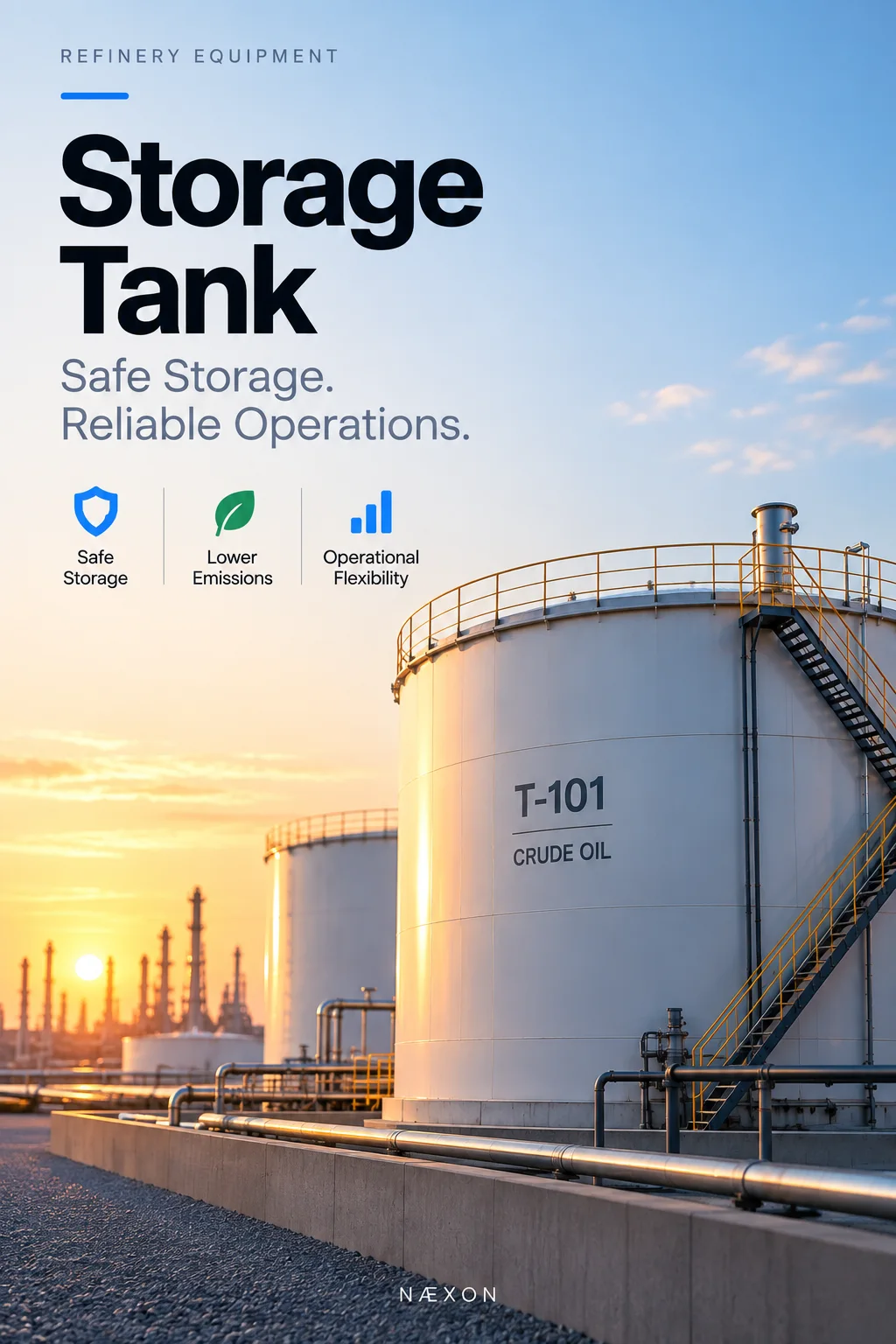
Storage tanks are some of the largest and most recognizable pieces of equipment in a refinery. Tank farms can contain enormous quantities of crude oil, intermediate hydrocarbons, finished fuels, water, and other liquids that must be safely stored between different stages of refining and distribution.
Unlike many process vessels designed for significant internal pressure, most refinery storage tanks operate at or near atmospheric pressure. Their job is to provide large-volume storage while controlling liquid level, vapor space, drainage, corrosion, emissions, and product movement.
For refinery workers and industrial tradespeople, understanding a storage tank means understanding much more than the steel shell. The complete system includes the roof, floor, foundation, nozzles, vents, gauging equipment, mixers, drains, piping, valves, secondary containment, fire protection, and, on some tanks, a floating roof.
What Is a Refinery Storage Tank?

Figure 1. Refinery Storage Tank System. Simplified storage tank diagram showing product inlet and outlet flow, floating roof, pressure/vacuum protection, level instrumentation, water draw, secondary containment, and transfer pumping to the next refinery destination.
A refinery storage tank is a large vessel designed to hold bulk liquids until they are needed elsewhere in the facility or transported off-site.
Depending on the refinery and tank design, tanks may contain:
- Crude oil.
- Gasoline components.
- Diesel.
- Jet-fuel components.
- Fuel oil.
- Intermediate process streams.
- Water.
- Slop oil.
- Asphalt and other heavy products.
- Certain chemicals or additives.
A simplified refinery storage path looks like:
Crude Delivery → Crude Storage → Crude Unit → Refining Processes → Product Storage → Pipeline / Terminal / Loading
Storage tanks act as buffers between different parts of the refinery.
Why Refineries Need Storage Tanks
A refinery operates continuously, but every process and transportation system does not always operate at exactly the same rate.
Storage tanks provide flexibility.
If crude arrives faster than the crude unit can process it, crude storage provides temporary inventory. If finished diesel is being produced before the next pipeline shipment is scheduled, product tanks provide somewhere to hold it.
Storage tanks help refineries:
- Maintain crude-oil inventory.
- Store finished products.
- Hold intermediate process streams.
- Blend different product components.
- Separate accumulated water from hydrocarbons in applicable services.
- Provide operational flexibility.
- Receive pipeline, marine, rail, or truck shipments.
- Supply outbound transportation systems.
Without adequate storage capacity, disruptions elsewhere in the refinery could quickly affect process-unit operation.
Major Types of Refinery Storage Tanks
Tank design depends heavily on the material being stored.
Three important designs are fixed-roof tanks, external floating-roof tanks, and internal floating-roof tanks.
Fixed-Roof Tank
A fixed-roof tank has a roof permanently attached to the tank shell.
Common configurations include cone roofs and dome roofs.
The liquid level rises and falls underneath the stationary roof, leaving a vapor space above the liquid.
The basic arrangement is:
Fixed Roof → Vapor Space → Liquid Product → Tank Bottom
Because vapor space exists above the liquid, the tank requires an appropriate venting or engineered vapor-management system.
External Floating-Roof Tank
An external floating roof sits directly on or very near the liquid surface and moves vertically as tank level changes.
When product enters:
Liquid Level Rises → Floating Roof Rises
When product leaves:
Liquid Level Falls → Floating Roof Falls
The major advantage is that the floating roof greatly reduces the vapor space immediately above the stored liquid.
This can reduce evaporation and emissions from volatile hydrocarbon products.
Internal Floating-Roof Tank
An internal floating-roof tank combines features of fixed-roof and floating-roof designs.
The tank has a permanent outer roof, but another floating deck moves with the liquid level inside the tank.
The basic arrangement is:
Fixed Outer Roof → Internal Floating Roof → Product
This provides exterior weather protection while reducing vapor space directly above the liquid.
Major Components of a Storage Tank
Shell
The shell forms the vertical wall of the tank.
Large tanks are constructed from multiple courses of steel plate welded together.
Shell thickness may vary from bottom to top because hydrostatic pressure is greatest near the bottom of the tank.
Tank Bottom
The tank bottom supports and contains the stored liquid while transferring loads into the foundation.
Tank-bottom condition is particularly important because corrosion or damage can potentially allow product to escape beneath the tank.
Roof
The roof may be fixed or floating depending on the tank design and stored product.
Floating roofs move with liquid level, while fixed roofs remain attached to the shell.
Nozzles
Tank nozzles provide connections for piping, equipment, and instrumentation.
Depending on service, connections may include:
- Product inlet.
- Product outlet.
- Drain.
- Water draw.
- Recirculation.
- Mixer connections.
- Instrument connections.
- Vapor connections.
- Overflow or emergency connections where applicable.
Nozzle arrangement varies significantly according to tank design and service.
Manways
Manways provide access for inspection, cleaning, and maintenance after the tank has been properly removed from service, isolated, prepared, and approved for entry.
Level Instrumentation
Knowing exactly how much liquid is inside a storage tank is critical.
Overfilling a hydrocarbon tank can become a major incident, so facilities may use multiple level-measurement, alarm, and independent overfill-protection systems depending on the application.
Vents
Atmospheric and low-pressure storage tanks must accommodate changes in vapor-space pressure.
When liquid enters the tank, vapor space decreases.
When liquid leaves, vapor space increases.
Ambient-temperature changes can also cause vapor-space expansion and contraction.
Proper venting is therefore essential.
How a Storage Tank Breathes
A storage tank effectively “breathes” as conditions change.
During filling:
Product In → Liquid Level Rises → Vapor Space Decreases → Vapor Must Be Managed
During withdrawal:
Product Out → Liquid Level Falls → Vapor Space Increases
Temperature changes can also affect vapor volume.
A tank heated by the sun during the day may experience different vapor-space conditions than the same tank during a cooler night.
This is one reason tank venting systems are so important.
A blocked or improperly isolated vent can expose the tank to dangerous pressure or vacuum.
Pressure and Vacuum Protection
Many atmospheric storage tanks are not designed to withstand substantial internal pressure or deep vacuum.
Pressure/vacuum protection helps keep the tank within its intended operating range.
Excessive internal pressure can damage the tank.
Excessive vacuum can also be destructive.
Because large storage tanks have relatively thin walls compared with many pressure vessels, excessive vacuum can potentially deform or buckle the tank.
Operating near atmospheric pressure does not mean a storage tank cannot fail dramatically.
Tank Overfilling
Overfilling is one of the most serious storage-tank hazards.
If incoming product continues after the tank reaches its safe operating capacity, hydrocarbon can potentially escape from the tank.
Possible consequences include:
- Large product spills.
- Flammable vapor-cloud formation.
- Fire.
- Environmental releases.
- Personnel exposure.
- Product entering containment areas.
- Escalation involving nearby equipment.
Reliable tank gauging, operating procedures, alarms, and overfill protection are therefore extremely important.
Floating-Roof Seals
Floating roofs require seals around the perimeter where the roof approaches the tank shell.
These seals help minimize the escape of hydrocarbon vapors.
Depending on the design, a floating roof may incorporate primary and secondary seals.
Damaged or deteriorated seals can increase emissions and create operating concerns.
Seal inspection is therefore an important part of floating-roof tank maintenance.
Floating-Roof Drains
Rainwater can accumulate on an external floating roof.
That water needs a controlled drainage path.
Floating-roof drain systems allow rainwater to leave the roof without intentionally mixing with the stored hydrocarbon.
A plugged or failed roof drain can become a serious problem.
Accumulated rainwater adds significant weight to the roof and can interfere with its normal operation and buoyancy.
Water at the Bottom of the Tank
Water can accumulate at the bottom of hydrocarbon storage tanks.
It may enter with the product, form through condensation, or originate from other sources.
Because water is denser than many hydrocarbon products, it tends to settle toward the bottom.
Applicable tanks may therefore include water-draw connections.
Water draining must be carefully controlled because eventually the hydrocarbon-water interface can approach the drain connection.
Tank Mixers
Some storage tanks contain mixers.
Mixers may be used to maintain product uniformity, improve blending, reduce settling, or prevent stratification.
A mixer may enter through a shell nozzle and drive an internal impeller.
For maintenance crews, mixer nozzles, shafts, seals, bearings, and associated components can become important inspection areas.
Tank Heating
Heavy refinery products can become increasingly viscous and difficult to pump as temperature decreases.
Certain storage tanks therefore incorporate heating systems.
Depending on the application, heating may involve steam coils or another engineered system.
Heating helps maintain the product at a suitable temperature and viscosity for storage and transfer.
This connects directly with the refinery steam system and the steam boiler, which supplies steam for numerous heating services throughout the facility.
Tank Foundations
A large storage tank can impose an enormous load on its foundation.
The foundation must support the tank and its contents while maintaining acceptable settlement.
Uneven settlement can affect:
- Tank shell.
- Tank bottom.
- Roof.
- Nozzles.
- Connected piping.
- Floating-roof operation.
- Overall tank integrity.
Tank inspection therefore considers not only the steel structure but also the condition and behavior of the foundation.
Secondary Containment
Storage tanks are commonly surrounded by engineered secondary containment such as dikes or berms.
Their purpose is to help contain released liquid if the primary tank leaks or fails.
The complete storage system should therefore be viewed as:
Storage Tank → Secondary Containment → Drainage → Fire Protection → Emergency Response
The open area surrounding a storage tank is not necessarily unused space. It can be an important part of the facility’s containment strategy.
Tank Farm Piping
Tank farms can contain extensive piping networks connecting tanks with pumps, manifolds, process units, pipelines, loading facilities, and other tanks.
Workers may encounter:
- Tank suction lines.
- Tank fill lines.
- Recirculation lines.
- Transfer manifolds.
- Water-draw piping.
- Drain systems.
- Firewater piping.
- Foam-system piping.
- Steam lines.
- Vapor-recovery piping.
Correct line identification is critical.
Several pipes may appear nearly identical while carrying completely different products or utilities.
Tank Transfer Pumps
Storage tanks frequently operate with centrifugal transfer pumps.
The basic arrangement is:
Tank → Suction Line → Transfer Pump → Header → Destination
The liquid level inside the tank provides static head at the pump suction.
As tank level decreases, available suction head can also decrease.
Tank level, fluid temperature, vapor pressure, piping resistance, and pump elevation can therefore influence pump performance and cavitation risk.
Storage-Tank Corrosion
Storage tanks can experience both internal and external corrosion.
Potential areas of concern include:
- Tank bottom.
- Bottom-to-shell region.
- Lower shell courses.
- Roof.
- Nozzles.
- Internal structural components.
- Floating-roof components.
- Areas beneath insulation where applicable.
The exact corrosion mechanisms depend on product composition, water content, temperature, materials, coatings, environmental conditions, and other factors.
Tank Inspection
Storage tanks require systematic inspection throughout their operating lives.
Depending on tank design, service, condition, and applicable requirements, inspections may include:
- Visual shell inspection.
- Roof inspection.
- Bottom inspection.
- Ultrasonic thickness measurements.
- Weld examination.
- Nozzle inspection.
- Floating-roof inspection.
- Seal inspection.
- Foundation assessment.
- Corrosion evaluation.
- Leak testing.
- Settlement surveys.
Major internal inspections generally require the tank to be removed from service, isolated, cleaned, ventilated, tested, and properly prepared for safe entry.
Tank Turnaround Work
Taking a large hydrocarbon storage tank out of service can become a major maintenance project.
Work may include:
- Product removal.
- Isolation.
- Cleaning.
- Degassing.
- Atmospheric testing.
- Sludge removal.
- Internal inspection.
- Bottom repairs.
- Shell repairs.
- Nozzle replacement.
- Roof repairs.
- Floating-roof maintenance.
- Seal replacement.
- Coating work.
- Piping modifications.
- Required testing before return to service.
Pipefitters, boilermakers, welders, inspectors, scaffold builders, operators, riggers, painters, electricians, instrumentation technicians, and other crafts may all become involved.
Tank Entry Hazards
An empty tank is not automatically a safe tank.
Residual hydrocarbons, sludge, toxic gases, oxygen deficiency, pyrophoric material, chemical residues, and other hazards can remain after the bulk product has been removed.
Potential tank-entry hazards include:
- Flammable vapor.
- Hydrogen sulfide in applicable services.
- Oxygen deficiency.
- Toxic exposure.
- Pyrophoric deposits.
- Slips and falls.
- Heat stress.
- Restricted access.
- Falling objects.
- Welding and hot-work hazards.
Tank entry must follow the facility’s confined-space, isolation, atmospheric-testing, ventilation, and work-control requirements.
Fire Protection
Hydrocarbon storage tanks can contain enormous fuel inventories.
Tank farms therefore incorporate engineered fire-protection strategies appropriate to the facility and tank service.
Depending on the installation, systems may include firewater, foam systems, monitors, hydrants, detection systems, and emergency-isolation arrangements.
Workers should never obstruct fire-protection equipment or assume piping near a storage tank is ordinary process piping simply because it looks similar.
Field Knowledge for Pipefitters
Tank piping deserves special attention because storage tanks can move.
Settlement, thermal expansion, filling, emptying, and shell movement can affect nozzle position.
Connected piping must accommodate the movement anticipated by the engineered design.
Important field considerations include:
- Nozzle alignment.
- Pipe supports.
- Piping flexibility.
- Settlement allowance.
- Tank-shell loading.
- Flange alignment.
- Valve accessibility.
- Drainability.
- Product identification.
- Thermal expansion.
Never pull a tank nozzle into alignment using flange bolts.
The piping should fit the equipment—not force the equipment to fit the piping.
Common Storage-Tank Problems
Corrosion
Internal or external corrosion can reduce plate thickness and eventually threaten containment.
Bottom Leaks
Tank-bottom deterioration can allow product to escape beneath the tank, where detection and repair can be difficult.
Floating-Roof Problems
Floating roofs can experience damaged seals, drainage problems, uneven movement, mechanical damage, or loss of buoyancy.
Vent Restrictions
Blocked or improperly isolated vents can expose the tank to damaging pressure or vacuum.
Water Accumulation
Water at the bottom of a hydrocarbon tank can contribute to corrosion, product-quality problems, and operating difficulties.
Instrument Failure
Incorrect level indication can become especially serious during filling operations.
Foundation Settlement
Uneven settlement can distort the tank, bottom, roof, and connected piping.
Troubleshooting Example
Suppose a transfer pump begins cavitating as a storage tank approaches its lower operating level.
The pump itself may not necessarily be defective.
The investigation could include:
- Tank liquid level.
- Pump suction pressure.
- Product temperature.
- Suction-line restrictions.
- Valve position.
- Strainer condition where applicable.
- Product vapor pressure.
- Pump elevation.
- Suction piping configuration.
The lower tank level may have reduced the available static head enough to expose another weakness in the suction system.
This reinforces an important troubleshooting principle:
The equipment showing the symptom is not always the equipment causing the problem.
Important Storage-Tank Terminology
- Tank Shell: Vertical wall of the storage tank.
- Tank Bottom: Steel floor containing the stored liquid.
- Fixed Roof: Roof permanently attached to the tank shell.
- Floating Roof: Roof that moves vertically with liquid level.
- Vapor Space: Gas-filled volume above the stored liquid.
- Tank Farm: Area containing multiple storage tanks.
- Dike/Berm: Secondary containment surrounding a tank or group of tanks.
- Water Draw: Connection used to remove accumulated water from applicable tanks.
- P/V Vent: Pressure/vacuum protection device.
- Manway: Opening used for personnel or maintenance access after proper preparation.
- Working Capacity: Usable storage volume within established operating limits.
- Heel: Product remaining near the bottom of a tank after normal withdrawal.
Field Rules
- Never assume an empty tank is safe. Hazardous atmospheres and residues can remain.
- Know the product before opening anything. Tank farms can contain many different services.
- Protect tank vents. Atmospheric tanks can be damaged by both excessive pressure and vacuum.
- Respect high-level alarms and overfill protection. Tank overfilling can become a major refinery incident.
- Never force piping onto a tank nozzle. Settlement, movement, and shell loading matter.
- Watch floating-roof drainage. Accumulated rainwater can add significant weight.
- Understand secondary containment. The dike surrounding the tank is part of the safety system.
- Remember that tanks move. Filling, emptying, temperature changes, and settlement can affect connected piping.
Knowledge Check
- What is the primary purpose of a refinery storage tank?
- What is the difference between a fixed-roof and floating-roof tank?
- Why are floating roofs used for certain hydrocarbon services?
- Why does an atmospheric storage tank require venting?
- What can happen if excessive vacuum develops inside a tank?
- Why is tank overfilling dangerous?
- What is the purpose of a floating-roof drain?
- Why can water accumulate at the bottom of a hydrocarbon tank?
- What is secondary containment?
- Why must tank piping accommodate movement?
- Why is an empty hydrocarbon tank not automatically safe to enter?
- What could cause a transfer pump to begin cavitating as tank level decreases?
Practical Exercise
Using a simplified refinery tank-farm drawing, select one hydrocarbon storage tank and trace its complete system.
Follow:
Product Inlet → Storage Tank → Product Outlet → Transfer Pump → Transfer Header
Then identify:
- Tank vent.
- Level instrumentation.
- High-level protection.
- Water draw.
- Drain.
- Manway.
- Fire-protection connections.
- Secondary containment.
- Tank foundation.
- Floating-roof drain and seals, if applicable.
Finally, determine what happens during three operating conditions: the tank filling, the tank emptying, and the tank sitting idle while ambient temperature changes.
Once you can visualize those conditions, tank venting, liquid level, vapor space, and connected piping behavior become much easier to understand.
The Big Picture
A refinery storage tank may look simple compared with a reactor or distillation column, but safely storing enormous quantities of hydrocarbons requires careful engineering.
The tank must contain the product, accommodate changing liquid levels, manage vapor-space pressure, resist corrosion, handle drainage, provide accurate level information, accommodate connected piping, and help protect the surrounding facility if something goes wrong.
Remember the basic refinery storage path:
Product Arrives → Tank Stores It → Level and Vapor Are Controlled → Product Is Withdrawn → Pump Transfers It to the Next Destination
Understanding a refinery storage tank means understanding not just the steel cylinder, but the entire storage, containment, transfer, and protection system surrounding it.
Equipment #16 — Storage Tank
Next: Equipment #17 — Flare System