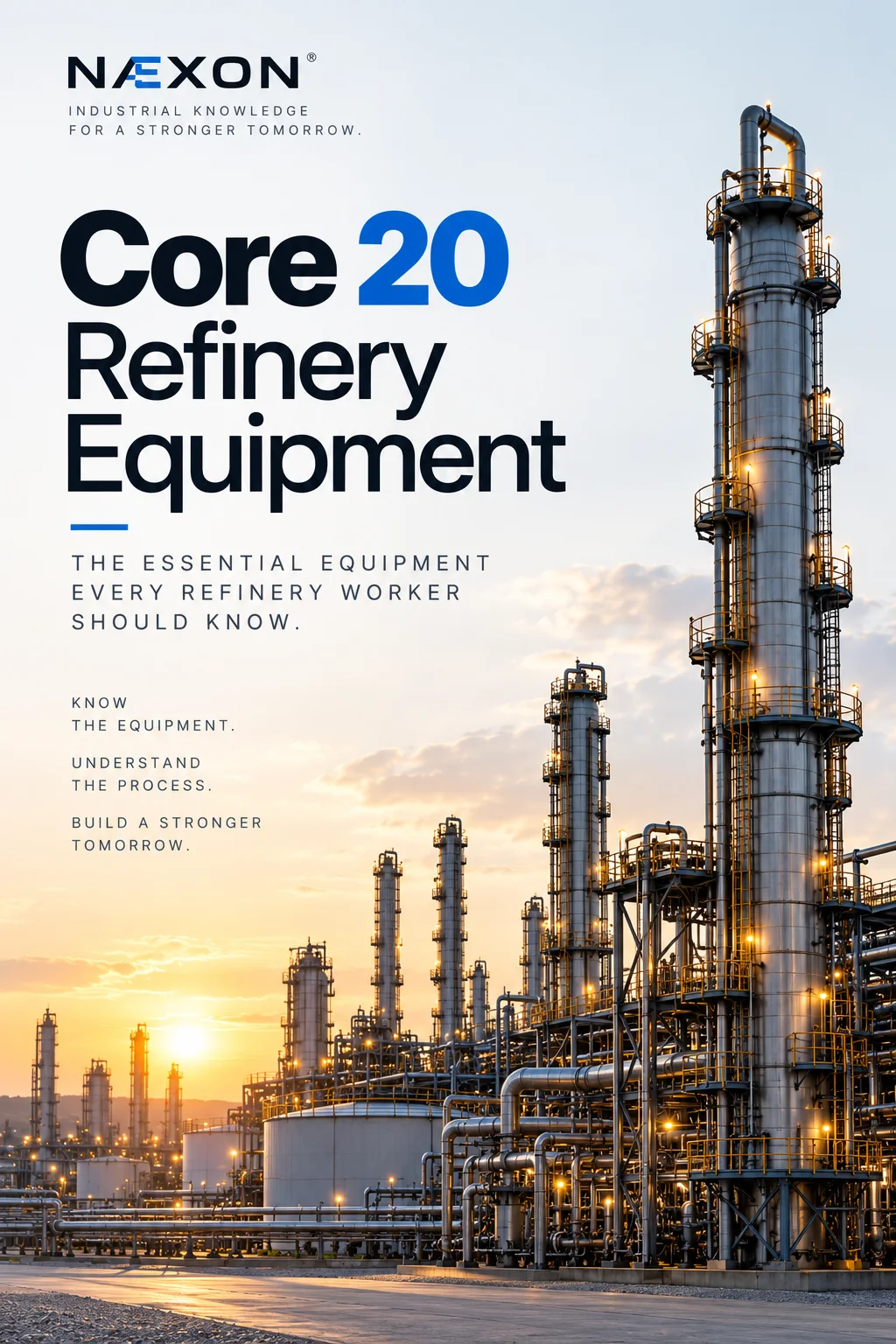
A refinery can contain thousands of pieces of equipment connected by miles of piping, valves, instrumentation, electrical systems, structural steel, and utility systems. To someone entering the industry, all of that equipment can make a refinery seem overwhelmingly complicated.
But there is a much easier way to understand it.
Start with the equipment that performs the refinery’s fundamental jobs.
Crude oil must be stored, moved, cleaned, heated, separated, converted, cooled, compressed, and processed. Steam and cooling systems must support those operations. Pressure must be controlled. Products must be stored. And when abnormal conditions occur, refinery systems must have a safe path for relieving pressure.
These Core 20 Refinery Equipment lessons provide a foundation for understanding those operations.
The goal is not simply to recognize a pump, tower, vessel, exchanger, or furnace from a photograph. A refinery worker should eventually be able to look at equipment and begin asking:
What enters it? What happens inside it? What leaves it? What equipment comes before it? What comes after it?
That is when equipment recognition becomes process knowledge.
1. Crude Distillation Column — CDU Tower
The crude distillation column is one of the primary starting points of refinery processing.
After crude oil has been prepared, desalted, preheated, and heated in the crude furnace, it enters the atmospheric distillation column. Inside the tower, hydrocarbons separate largely according to differences in boiling range.
Lighter components move toward the upper portions of the tower while progressively heavier fractions are withdrawn lower in the column.
Heated Crude → Atmospheric Distillation → Multiple Hydrocarbon Fractions
The crude tower primarily separates hydrocarbons rather than chemically converting them.
Understanding the CDU introduces several fundamental refinery concepts including vaporization, condensation, trays, reflux, pumparounds, side draws, overhead systems, and fractionation.
The crude tower also demonstrates an important principle that applies throughout this Core 20 series: equipment rarely works alone. Pumps, heat exchangers, the desalter, fired heater, condenser, separators, and associated piping all support the crude distillation process.
2. Vacuum Distillation Column — VDU Tower
Atmospheric distillation cannot efficiently recover every useful hydrocarbon from the heaviest portion of crude oil.
Atmospheric residue can therefore be sent to a vacuum distillation unit.
The vacuum tower operates below atmospheric pressure. Reducing pressure allows heavy hydrocarbons to vaporize at lower temperatures than they would require at atmospheric pressure.
Lower Pressure → Lower Boiling Temperature
This allows additional valuable material to be recovered while limiting the extreme temperatures that could otherwise cause unwanted thermal cracking.
Vacuum distillation can produce streams such as vacuum gas oils while leaving a very heavy vacuum residue.
That residue may become feed for another piece of equipment in the Core 20—the coke drum system of a delayed coker.
3. Shell-and-Tube Heat Exchanger
Heat exchangers are found throughout nearly every refinery process unit.
Their purpose is to transfer thermal energy between fluids without intentionally mixing those fluids.
In a typical shell-and-tube exchanger, one process fluid travels through tubes while another flows around those tubes inside the shell.
Hot Process Stream → Gives Up Heat
Cold Process Stream → Receives Heat
This allows refineries to recover energy that would otherwise be wasted.
Heat exchangers are particularly important in crude-unit preheat trains, where hot refinery streams transfer energy into incoming crude before the crude reaches the fired heater.
For pipefitters and maintenance crews, exchangers introduce important field concepts including tube sheets, bundles, channel heads, bonnets, shell-side piping, tube-side piping, thermal expansion, fouling, nozzle loads, and bundle removal.
4. Air-Cooled Heat Exchanger — Fin-Fan
Not every refinery stream is cooled using cooling water.
An air-cooled heat exchanger, commonly called a fin-fan, uses atmospheric air to remove heat from process fluid traveling through finned tubes.
Large fans move air across the tube bundles.
Hot Process Fluid → Finned Tubes → Air Removes Heat → Cooler Process Fluid
Fin-fans are easy to recognize because they are frequently installed on elevated structural frames with large fans above or below the tube bundles.
Important components include headers, finned tubes, fans, motors, drives, louvers, structural framing, and process piping.
The concept is simple: instead of transferring process heat into cooling water, the system ultimately transfers that heat into the surrounding air.
5. Cooling Tower
Cooling water absorbs enormous quantities of heat throughout a refinery.
Instead of continuously replacing that water, much of it can be circulated through a cooling-water system.
Warm cooling water returns to the cooling tower and contacts moving air. A small portion of the water evaporates, removing heat from the remaining water.
The cooler water collects below the tower and returns to refinery users.
Cooling Tower → Cool Water → Process Equipment → Warm Water → Cooling Tower
Cooling-water users can include heat exchangers, condensers, compressors, and many other systems.
The cooling tower therefore connects to equipment throughout the refinery even though it may be located far away from the process unit being cooled.
6. Centrifugal Pump
If liquid is moving through a refinery, there is a good chance a pump is responsible.
Centrifugal pumps use a rotating impeller to add energy to a liquid.
The basic path is:
Suction → Impeller → Pump Casing → Discharge
Refinery pumps move crude oil, water, hydrocarbons, chemicals, condensate, intermediate products, and finished products.
Important field concepts include suction conditions, discharge pressure, cavitation, mechanical seals, bearings, alignment, baseplates, strainers, minimum-flow systems, and piping loads.
One of the most important lessons for tradespeople is that a pump should never be considered separately from its piping.
A poorly designed, installed, supported, or aligned piping system can create problems that appear to be pump problems.
7. Reciprocating Compressor
Liquids are commonly moved with pumps. Gases frequently require compressors.
A reciprocating compressor compresses gas using pistons moving inside cylinders.
Gas Enters Cylinder → Piston Compresses Gas → Higher-Pressure Gas Discharges
These machines can achieve substantial pressure increases and are used in various refinery gas services.
Important components and concepts include cylinders, pistons, piston rods, suction and discharge valves, packing, pulsation bottles, lubrication systems, unloading systems, vibration, and connected piping.
Because the compression process creates pulsations, the piping system surrounding a reciprocating compressor deserves particular attention.
8. Centrifugal Compressor
Centrifugal compressors are commonly used when large quantities of gas must be moved and compressed continuously.
A rapidly rotating impeller adds velocity to the gas. The compressor then converts part of that velocity into pressure.
Low-Pressure Gas → Impeller → Increased Velocity → Pressure Recovery → Higher-Pressure Gas
These machines can be critical to an entire process unit.
Supporting systems may include lubrication, seals, cooling, instrumentation, anti-surge controls, and a turbine or motor driver.
A compressor trip can sometimes affect far more than the compressor itself. Loss of compression can disturb an entire process and, depending on the system, contribute to increased flare activity.
9. Fired Heater / Process Furnace
Heat recovery from exchangers can only take a process so far.
When additional temperature is required, a refinery may use a fired heater or process furnace.
Fuel is burned inside the heater and thermal energy is transferred into process fluid flowing through tubes.
Fuel + Air → Combustion → Heat → Process Tubes → Hot Process Fluid
Major components can include burners, radiant tubes, convection tubes, refractory, stacks, combustion-air systems, fuel-gas piping, and instrumentation.
Fired heaters are central to major refinery processes.
In the crude unit, the furnace provides the heat required before crude enters the atmospheric distillation column. In delayed coking, the coker furnace heats heavy residue before it enters the coke drums.
10. Process Reactor
A reactor performs a fundamentally different job from a distillation tower.
Distillation primarily separates molecules that already exist in a mixture.
A reactor is designed so controlled chemical reactions can change those molecules.
Feed → Controlled Chemical Reaction → Changed Product
Depending on the refinery process, reactors can operate with catalyst, hydrogen, high pressure, elevated temperature, or combinations of these conditions.
Reactors are found in processes including hydrotreating, hydrocracking, catalytic reforming, and other treating and conversion units.
For field workers, understanding the reactor also means understanding its connected piping, internals, catalyst systems, temperature requirements, pressure boundaries, relief protection, and shutdown conditions.
11. Pressure Vessel / Separator
Pressure vessels perform many jobs throughout a refinery.
One of the most common is phase separation.
A mixed stream can enter a separator and be given enough space and residence time for gas and liquid to separate.
Mixed Feed → Separator → Gas + Liquid
More complex vessels may separate gas, hydrocarbon liquid, and water.
Depending on design, vessels can contain inlet devices, baffles, demisters, level controls, drains, relief protection, and other internals.
The lesson is important: what looks like an empty steel vessel from the outside may contain carefully designed internals that determine how the process performs.
12. Reboiler
A distillation tower requires vapor moving upward through the column.
A reboiler helps provide that vapor.
Liquid from the lower portion of the column enters or circulates through the reboiler, receives heat, and partially vaporizes.
Column Bottom Liquid → Reboiler → Partial Vaporization → Vapor Returns to Column
That vapor returns to the tower and helps drive separation.
The reboiler is an excellent example of how individual pieces of refinery equipment operate as systems.
The tower and reboiler may be physically separate equipment, but from a process standpoint their operation is closely connected.
13. Condenser
At the opposite end of many distillation systems is the condenser.
A condenser removes heat from vapor until some or all of that vapor changes into liquid.
Hot Vapor → Heat Removed → Condensation → Liquid
For a distillation tower, overhead vapor can leave the top of the column and travel through a condenser.
The resulting material may then enter an overhead receiver or separator where hydrocarbon liquid, water, and remaining vapor can be separated.
Some condensed hydrocarbon may return to the tower as reflux.
The reboiler and condenser therefore perform opposite but complementary jobs:
Reboiler → Adds Heat
Condenser → Removes Heat
Together they help establish the internal vapor-and-liquid traffic necessary for distillation.
14. Steam Boiler
Steam is one of the most important utilities in a refinery.
A boiler uses heat from combustion to convert treated water into steam.
A simplified water-tube boiler process is:
Treated Feedwater → Economizer → Boiler → Steam Drum → Superheater → Steam Header
Steam can support:
- Process heating.
- Reboilers.
- Steam turbines.
- Ejectors.
- Steam tracing.
- Tank heating.
- Stripping.
- Equipment preparation and maintenance activities.
Once steam gives up useful energy, condensate can often be recovered and returned toward the boiler-water system.
That creates another refinery cycle rather than a simple one-way process.
15. Deaerator
Before boiler feedwater enters the boiler, dissolved gases should be minimized.
The deaerator heats incoming water and helps remove dissolved oxygen and other non-condensable gases.
Condensate + Makeup Water → Deaerator → Deaerated Water → Boiler Feedwater Pump → Boiler
Removing dissolved oxygen helps reduce corrosion within the boiler feedwater and steam-condensate system.
The deaerator demonstrates why understanding utilities is just as important as understanding hydrocarbon equipment.
Without reliable steam, many refinery processes cannot operate properly.
16. Storage Tank
Storage tanks provide inventory and operational flexibility.
Depending on service, refinery tanks can contain:
- Crude oil.
- Intermediate hydrocarbons.
- Finished fuels.
- Heavy products.
- Water.
- Slop oil.
- Other refinery liquids.
Tank designs can include fixed-roof tanks, external floating-roof tanks, and internal floating-roof tanks.
But the tank itself is only part of the system.
Level instrumentation, vents, drains, foundations, secondary containment, transfer pumps, mixers, heating systems, connected piping, fire protection, and overfill protection can all be critical.
The basic movement is:
Product Arrives → Storage → Transfer Pump → Next Destination
17. Flare System
The refinery flare is much more than the flame visible above a facility.
The flare stack is the final part of a much larger pressure-relief and disposal network.
When appropriate process equipment must relieve pressure, hydrocarbon gases and vapors can enter the flare system.
Process Equipment → Relief Device → Flare Header → Knockout Drum → Flare Stack → Flare Tip
The knockout drum helps remove bulk liquid before gas continues toward the flare.
Pilots maintain an available ignition source so appropriate relief gas reaching the flare tip can be burned in a controlled location.
For pipefitters, the flare system introduces particularly important concepts involving header slope, drainage, thermal expansion, supports, relief-line routing, and liquid accumulation.
18. FCC Reactor & Regenerator
The Fluid Catalytic Cracking unit converts heavy hydrocarbon molecules into smaller, more valuable hydrocarbons.
At the center of the FCC process are the reactor and regenerator.
Heavy feed contacts hot regenerated catalyst. Cracking occurs rapidly, producing lighter hydrocarbon vapors while coke deposits on the catalyst.
The spent catalyst then moves toward the regenerator.
Air is introduced and the coke is burned from the catalyst, reheating and regenerating it.
The catalyst then returns to the reactor.
Regenerator → Hot Regenerated Catalyst → Reactor → Spent Catalyst → Regenerator
The FCC demonstrates several refinery principles operating simultaneously: chemical conversion, fluidization, catalyst circulation, combustion, separation, heat transfer, and pressure control.
19. Coke Drum
Coke drums are central to the delayed coking process.
Very heavy refinery residue is heated rapidly in the coker furnace and routed into a coke drum.
Thermal cracking continues inside the drum.
Heavy Residue → Coker Furnace → Coke Drum → Lighter Hydrocarbon Vapors + Petroleum Coke
The lighter vapors leave the drum and continue toward fractionation.
Solid petroleum coke remains inside.
Because the coke eventually fills the drum, delayed cokers typically use multiple drums so processing can continue while another drum is taken through its offline cycle.
A simplified cycle is:
Warm → Fill → Steam → Cool → Drain → Open → Decoke → Close → Prepare
This repeated heating and cooling creates severe thermal cycling.
Coke drums therefore teach tradespeople valuable lessons about thermal growth, shell movement, piping flexibility, supports, cracking, inspection, and the hazards associated with opening and decoking process equipment.
20. Crude Oil Desalter
The desalter protects the refinery before crude reaches the primary distillation process.
Crude oil can contain water, dissolved salts, sediment, and other contaminants.
Wash water is mixed with heated crude so salts can transfer into the water phase.
Inside an electrostatic desalter, small water droplets are encouraged to combine into larger droplets that settle more easily.
Heated Crude + Wash Water → Mixing → Electrostatic Coalescence → Oil/Water Separation
The two primary paths then become:
Desalted Crude → Crude Unit
Brine + Salt + Sediment → Effluent System
Desalting helps protect downstream exchangers, fired heaters, piping, and crude-unit equipment from conditions that can contribute to fouling, deposits, and corrosion.
The desalter does not directly produce gasoline, diesel, or jet fuel.
It performs something just as important:
It protects the equipment that eventually does.
How the Core 20 Work Together
The best way to understand these twenty pieces of equipment is not to memorize twenty definitions.
Connect them.
Imagine crude oil arriving at the refinery.
It can begin in a storage tank.
A centrifugal pump moves it into the process.
Shell-and-tube heat exchangers recover energy from hotter refinery streams and begin warming the crude.
The desalter removes salt-containing water, sediment, and other contaminants.
Additional heat recovery occurs before the crude reaches the fired heater.
The furnace raises the crude to the temperature required for atmospheric separation.
Then the crude enters the crude distillation column.
The sequence begins to look like this:
Storage Tank → Centrifugal Pump → Heat Exchangers → Desalter → Fired Heater → Crude Distillation Column
Now the refinery starts making more sense.
Follow the Heavy Material
The heaviest material leaving atmospheric distillation may continue toward the vacuum distillation column.
Crude Distillation → Atmospheric Residue → Vacuum Distillation
Vacuum distillation recovers additional useful material without requiring unnecessarily extreme temperatures.
Heavy streams can then become feed for conversion units.
One path may lead toward the FCC:
Heavy Feed → FCC Reactor & Regenerator → Lighter Hydrocarbons
Another heavy residue stream may move toward delayed coking:
Vacuum Residue → Coker Furnace → Coke Drums → Lighter Hydrocarbons + Petroleum Coke
Now equipment that initially appeared unrelated becomes part of a process chain.
Follow the Heat
Heat is constantly being added, recovered, transferred, and removed throughout a refinery.
A shell-and-tube heat exchanger transfers heat between process streams.
A fired heater adds additional thermal energy through combustion.
A reboiler adds heat to support distillation.
A condenser removes heat and changes vapor back into liquid.
A fin-fan rejects heat into atmospheric air.
A cooling tower removes heat from circulating cooling water so that water can return to refinery users.
Together:
Recover Heat → Add Heat → Use Heat → Remove Heat → Reject Heat
Energy movement is one of the hidden systems connecting the entire refinery.
Follow the Steam
The utility side has its own equipment chain.
Condensate and makeup water can enter the deaerator.
The deaerator removes dissolved gases and supplies hot boiler feedwater.
The steam boiler converts that treated water into steam.
Steam then travels through refinery headers toward process users.
Condensate + Makeup Water → Deaerator → Boiler Feedwater Pump → Steam Boiler → Steam Header → Process Users
Steam can support reboilers, turbines, tracing systems, tank heating, stripping operations, and many other refinery services.
When useful condensate is recovered, it can eventually return toward the boiler-water system.
Again, the refinery operates in cycles.
Follow Pressure and Flow
Pumps move liquids.
Compressors move and increase the pressure of gases.
Separators divide process phases.
Pressure vessels contain process fluids under controlled conditions.
And when designated equipment must relieve pressure during abnormal conditions, the relief system can provide a path toward the flare system.
Process Equipment → Relief Device → Flare Header → Knockout Drum → Flare Stack
Understanding refinery equipment therefore means understanding more than individual machines.
It means understanding flow, pressure, temperature, phase, energy, and destination.
What Every Refinery Worker Should Ask
Whenever you encounter unfamiliar equipment, start asking questions.
- What is this equipment called?
- What is its primary purpose?
- What enters it?
- What leaves it?
- Is the process material liquid, vapor, solid, or multiphase?
- What equipment is immediately upstream?
- What equipment is immediately downstream?
- What temperature does it normally operate at?
- What pressure does it normally operate at?
- How does it expand when heated?
- Where does it drain?
- Where does it vent?
- Where does it relieve?
- What happens if flow stops?
- What happens if pressure rises?
- What happens if cooling is lost?
- What energy could remain after shutdown?
- What must happen before the equipment can safely be opened?
Those questions begin turning a craft worker into someone who understands the process surrounding the craft.
Field Rules
- Follow the process. Find where the material comes from and where it goes.
- Learn systems instead of memorizing isolated equipment.
- Never view equipment separately from its piping.
- Understand temperature and thermal movement.
- Understand pressure and stored energy.
- Know where equipment drains and vents.
- Know where pressure relief ultimately goes.
- Learn normal operation before trying to understand abnormal operation.
- Look upstream when troubleshooting downstream symptoms.
- Look downstream when evaluating the consequences of an upstream problem.
- Never assume an empty vessel is a safe vessel.
- Never force piping into equipment alignment.
- Respect process boundaries even when equipment is shut down.
- Know what is inside the pipe—not just the pipe size and material.
- Understand the entire system surrounding your work.
Core 20 Knowledge Check
- What is the primary purpose of the crude distillation column?
- Why does a vacuum tower operate below atmospheric pressure?
- What does a shell-and-tube heat exchanger transfer?
- How does an air-cooled heat exchanger remove process heat?
- Why does a refinery use a cooling tower?
- What does a centrifugal pump add to a liquid?
- How does a reciprocating compressor compress gas?
- How does a centrifugal compressor increase gas pressure?
- What is the purpose of a fired heater?
- How is a process reactor fundamentally different from a distillation column?
- What is the purpose of a separator?
- Why does a distillation column use a reboiler?
- What happens inside a condenser?
- Why is steam important throughout a refinery?
- What does a deaerator remove from boiler feedwater?
- Why is a storage tank more than simply a steel container?
- What is the purpose of the refinery flare system?
- What continuously circulates between the FCC reactor and regenerator?
- Why does a delayed coker typically have multiple coke drums?
- What does the crude oil desalter remove before crude enters downstream processing?
Practical Exercise: Trace the Refinery
Take a blank sheet of paper and begin with a crude-oil storage tank.
Draw this process:
Storage Tank → Centrifugal Pump → Preheat Exchangers → Desalter → Fired Heater → Crude Distillation Column
Now continue the heavy material:
Crude Tower Bottoms → Vacuum Distillation Column
Create two possible conversion paths.
First:
Heavy Feed → FCC Reactor & Regenerator → Lighter Products
Second:
Vacuum Residue → Coker Furnace → Coke Drums → Lighter Products + Petroleum Coke
Next, add the major supporting equipment around those processes:
- Reboilers.
- Condensers.
- Separators.
- Pumps.
- Compressors.
- Fin-fans.
- Cooling-water systems.
- Steam systems.
- Pressure-relief and flare systems.
Finally, draw arrows showing how energy and material move between the equipment.
The drawing does not need to resemble an engineering P&ID.
The objective is to understand relationships.
If you can explain why each piece of equipment exists and what equipment is likely to come before and after it, you are beginning to see the refinery as a process rather than a collection of steel.
The Big Picture
A refinery performs a surprisingly understandable group of fundamental jobs:
Store → Move → Clean → Heat → Separate → React → Convert → Cool → Compress → Recover → Protect
The Core 20 are the equipment behind those jobs.
Storage tanks hold inventory. Pumps move liquids. Heat exchangers recover energy. The desalter cleans incoming crude. Fired heaters add heat. Distillation towers separate hydrocarbons. Reactors change molecules. Reboilers and condensers support separation. Compressors move gases. Cooling systems reject heat. Boilers and deaerators support refinery steam. FCC equipment and coke drums convert heavy hydrocarbons into more useful products. The flare system provides a critical destination for appropriate relief streams.
No single piece of equipment makes a refinery operate.
The refinery works because these systems work together.
Once you understand these twenty pieces of equipment, the thousands of pipes, valves, vessels, instruments, machines, and structures around you begin to have context.
You stop seeing individual pieces of steel.
You begin seeing a process.
Master the Core 20. Then build from there.
Continue Learning
Explore the complete Næxon Learning Center for refinery equipment lessons, industrial process knowledge, piping, welding, rigging, drawing interpretation, and field skills.
NÆXON — Know the Equipment. Build a Stronger Tomorrow.
Important publishing note: I have intentionally not inserted guessed individual URLs into this copy. Næxon’s individual September equipment posts are not currently being returned by the public search index I can access, so I will not fabricate permalinks. The article above is publication-ready in content, but the 20 direct links still need the exact post URLs from your sitemap. The Learning Center itself is here: Næxon Learning Center.
