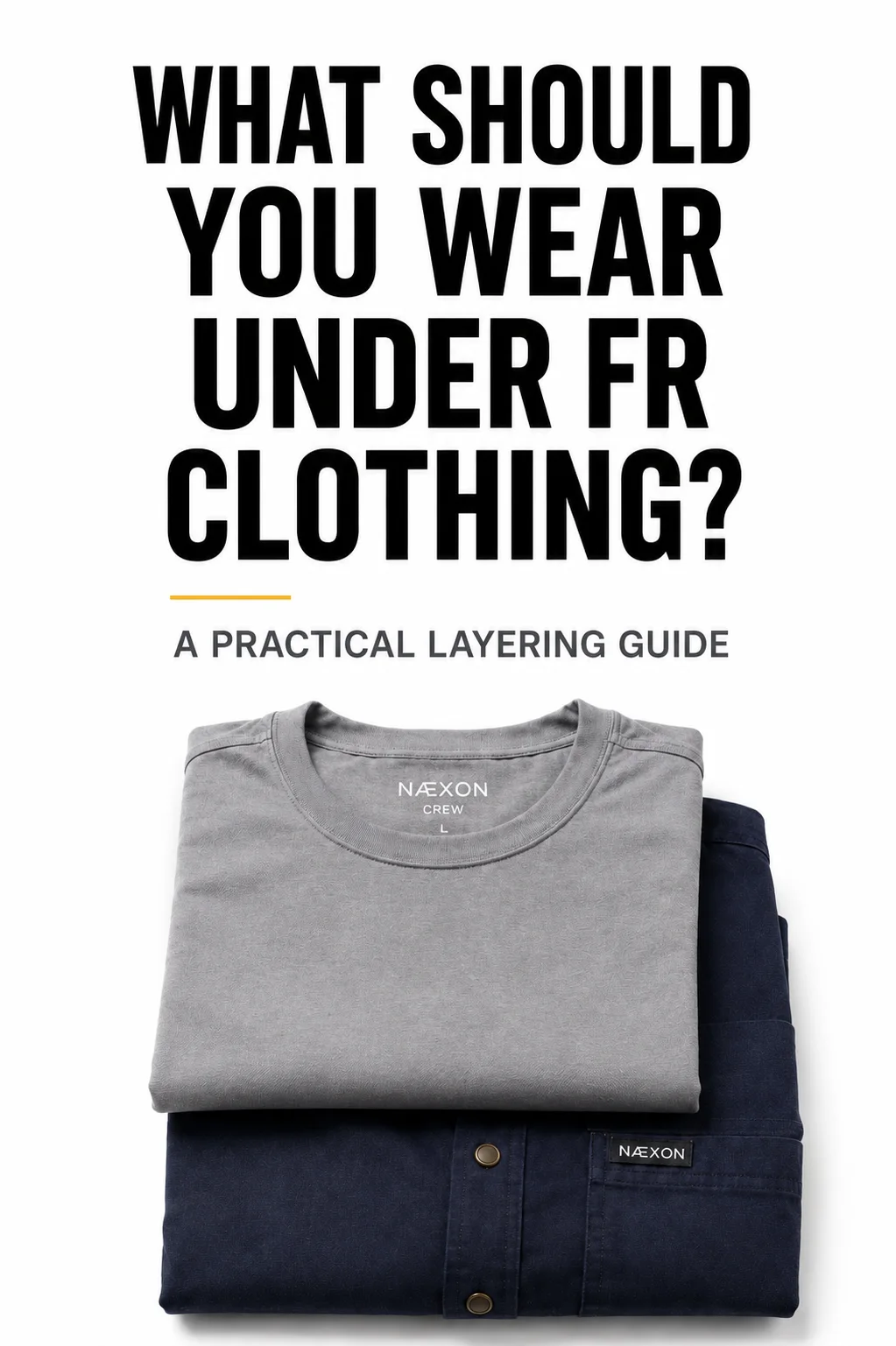
You bought the FR shirt. You checked the label. You made sure it meets the requirements for your job.
Then you put another shirt underneath it.
Does that matter?
Yes. What you wear underneath FR clothing can matter just as much as workers realize the outer garment does.
An FR shirt is only one part of the clothing system on your body. During a thermal event, heat can transfer through the outer garment, which means the material underneath it can also be exposed to significant thermal energy.
That’s why workers in refineries, petrochemical facilities, oil and gas operations, power plants, utilities, and other industrial environments should understand what they’re actually layering beneath their protective workwear.
The basic principle is simple:
Don’t think only about the FR shirt. Think about everything you’re wearing.
Why Does It Matter What You Wear Under FR Clothing?
FR means flame resistant.
Flame-resistant clothing is designed to resist ignition and flame propagation rather than continuing to burn against the body after an ignition source is removed.
It does not make someone fireproof.
Næxon’s What Does FR Mean on Clothing? The Complete Guide to Flame-Resistant Workwear explains the fundamentals of how FR clothing works and why industrial workers wear it.
The important thing to understand about layering is that the FR garment doesn’t create an invisible barrier around everything underneath it.
Heat can still transfer through protective clothing.
That makes the materials underneath worth considering.
Can You Wear a Regular Shirt Under an FR Shirt?
Whether a particular underlayer is acceptable depends on the hazard, garment materials, applicable requirements, and your employer’s PPE program.
Don’t assume every T-shirt is appropriate simply because nobody can see it underneath your FR shirt.
Read the tag.
A shirt that looks and feels like an ordinary cotton T-shirt may actually contain polyester, nylon, spandex, or other synthetic fibers.
That can matter during thermal exposure because certain synthetic materials can melt, soften, shrink, or otherwise behave differently when subjected to sufficient heat.
The safest approach is to know exactly what you’re wearing and follow the requirements established for your job.
Why Some Synthetic Base Layers Can Be a Problem
Modern athletic shirts are comfortable for a reason.
They’re lightweight, stretchy, breathable, and often excellent at moving moisture away from the body.
Those qualities make them attractive to industrial workers dealing with twelve-hour shifts in summer heat.
But comfort doesn’t automatically make a garment appropriate beneath protective clothing.
Some synthetic fibers can melt when exposed to sufficient thermal energy.
That creates a different concern from simply asking whether the material will ignite.
This is why you shouldn’t grab an ordinary gym compression shirt and automatically assume it’s appropriate underneath your FR.
The material matters.
What About Cotton Under FR Clothing?
You’ve probably heard the old jobsite advice:
“Just wear cotton underneath it.”
There is some reasoning behind workers paying attention to non-melting materials, but ordinary cotton shouldn’t be confused with flame-resistant clothing.
Cotton can burn.
A regular cotton T-shirt doesn’t become FR simply because you’re wearing an FR shirt over it.
Whether a non-FR natural-fiber underlayer is permitted depends on the protective clothing requirements for the hazard you’re facing.
If an FR or arc-rated base layer is specifically required, ordinary cotton isn’t a substitute.
What About a Næxon Crew Shirt as a Base Layer?
For workers looking for a lightweight shirt underneath their workwear, the Næxon Crew Shirt collection is a practical option when the job’s PPE requirements permit that type of underlayer.
Næxon Crew Shirts were developed around the conditions tradesmen actually deal with: long shifts, heat, constant movement, driving, climbing, bending, fabrication work, and hours spent inside heavier workwear.
Their lightweight construction helps reduce unnecessary bulk underneath another garment. The stretch-oriented material allows the shirt to move with the body, while breathable and quick-drying performance makes the Crew Shirt particularly useful when sweat becomes part of the workday.
That’s why we consider the Næxon Crew Shirt an everyday cruiser and a useful base-layer option where appropriate.
The collection includes options such as Black, Wolf Gray, Navy Blue, Tan, and Black + Næxon Stealth, giving workers the same basic lightweight Crew Shirt philosophy in different designs.
But there is an important distinction:
A Næxon Crew Shirt should not be treated as a substitute for an FR or arc-rated base layer when the hazard assessment, employer, facility, or applicable requirement calls for one.
That’s exactly why understanding layering matters.
Use the Crew Shirt as a lightweight base layer where its material and construction are appropriate for the workplace requirements. When specialized flame-resistant or arc-rated underlayers are required, wear the protective system specified for that hazard.
Why the Næxon Crew Shirt Makes Sense for Long Shifts
Anyone who has worked underneath heavier industrial clothing knows what happens several hours into a summer shift.
Sweat starts building.
Your undershirt gets soaked.
Your outer shirt begins sticking to it.
Every time you climb, reach, or bend, you’re moving two layers of clothing instead of one.
A bulky undershirt makes the situation worse.
That’s where a lightweight base layer has an advantage.
The Næxon Crew Shirt is designed to be lightweight, breathable, highly stretchable, and quick drying. Instead of adding another heavy work shirt underneath your outer garment, the idea is to keep the base layer relatively light and movement friendly.
That becomes especially useful during shutdowns and turnarounds when twelve-hour shifts can continue for weeks.
Comfort doesn’t replace protection.
But when the PPE requirements allow it, better comfort can make a long industrial shift considerably easier.
FR Base Layers Are a Different Category
There are situations where an actual flame-resistant base layer may be required or preferred.
That’s different from simply choosing a comfortable shirt underneath your FR.
An FR base layer is specifically designed with flame-resistant performance in mind. Depending on the hazard and protective clothing system, additional FR layers can play an important role.
Don’t assume that wearing two ordinary shirts underneath an FR shirt creates the same result.
It doesn’t.
And don’t assume that wearing two FR garments automatically gives you twice the protection.
Protective clothing systems are more complicated than that.
What About Arc-Rated Base Layers?
Electrical workers need to pay even closer attention.
Arc-rated clothing is specifically evaluated for electric-arc thermal exposure.
This is where understanding AR versus FR becomes critical.
All arc-rated clothing is flame resistant, but not all flame-resistant clothing is necessarily arc rated.
Næxon’s AR vs. FR Clothing: They Are Not the Same Thing explains that distinction in detail.
If you’re working around electrical hazards and see a garment rating expressed in cal/cm², Næxon’s What Is an ATPV Rating? Understanding cal/cm² Without the Engineering Talk explains what those numbers mean.
Never assume a general-purpose base layer provides an arc rating unless the garment is actually rated and identified accordingly.
Does Wearing Two FR Shirts Double the Protection?
No.
You can’t take two garment ratings, add the numbers together, and declare that you’ve created a new protective rating.
Layered systems can perform differently from individual garments because the interaction between fabrics, air spaces, construction, fit, and thermal exposure affects overall performance.
Proper layering can increase thermal insulation and can be part of a higher-performing protective system.
But the protection of that system needs to be established appropriately.
Jobsite arithmetic isn’t a substitute for an evaluated protective clothing system.
Can You Wear Compression Shirts Under FR?
Be careful here.
Many compression shirts and athletic base layers contain high percentages of synthetic fibers.
They’re popular because they’re thin, stretchy, and excellent at managing sweat.
Those same characteristics don’t automatically make them appropriate for thermal hazards.
Check the material.
Check your employer’s requirements.
Don’t assume that because the compression shirt is hidden underneath your FR, it doesn’t matter.
During a thermal incident, every layer on your body becomes part of the equation.
What About Polyester?
Polyester appears in countless everyday garments.
T-shirts.
Hoodies.
Thermals.
Athletic shirts.
Compression clothing.
Socks.
Jackets.
Workers exposed to thermal hazards need to understand that some synthetic materials can melt under sufficient heat.
That doesn’t mean you should make universal assumptions about every garment containing a synthetic fiber. It means you need to select clothing according to the hazard and applicable requirements rather than treating all base layers as interchangeable.
Read the garment label instead of guessing by feel.
Cotton-Polyester Blends Can Be Easy to Miss
This catches workers all the time.
A shirt feels like cotton.
It looks like cotton.
You’ve called it your cotton shirt for three years.
Then you finally read the label and discover it’s a blend.
Modern textiles make it difficult to identify fiber content by touch alone.
Turn the shirt around and read the tag.
Five seconds can tell you more than rubbing the fabric between your fingers.
Can You Wear a Hoodie Under FR?
Cold-weather work makes layering more complicated.
Workers start stacking clothing:
Thermals.
T-shirt.
Hoodie.
FR shirt.
Jacket.
Suddenly there are four or five different materials between the worker and the environment.
A regular hoodie isn’t automatically appropriate simply because an FR garment is worn over it.
Many everyday hoodies contain significant amounts of synthetic material.
If you’re working in an environment requiring specialized protective clothing, your cold-weather layers need to comply with the applicable requirements too.
Winter doesn’t eliminate the hazard.
What About Wearing a Hoodie Over Your FR Shirt?
The same principle works in the opposite direction.
Putting inappropriate outerwear over protective clothing can undermine the purpose of wearing an FR outer layer.
If FR outerwear is required, the garments worn over your FR shirt may also need to meet the applicable protective requirements.
That can include hoodies, jackets, vests, rainwear, and cold-weather gear.
Don’t spend money on the correct FR shirt and then bury it underneath an inappropriate outer garment.
Think about the entire clothing system.
Layering During a Summer Turnaround
Summer shutdowns create the opposite problem.
You’re working twelve hours.
It’s 95 degrees outside.
You’re surrounded by steel, concrete, piping, equipment, and hot surfaces.
Every additional layer starts feeling like insulation you don’t want.
That’s where workers begin stripping away whatever they can.
The better approach is to select the lightest, most comfortable clothing system that still satisfies the protective requirements of the job.
Where permitted, this is one of the environments where the Næxon Crew Shirt makes sense as a lightweight base layer.
Its breathable, quick-drying, stretch-oriented design helps manage the everyday comfort side of industrial layering without adding the bulk of another heavy work shirt.
Then the required protective clothing goes over it.
Comfort underneath. Required protection outside.
When the job requires a different base-layer specification, follow the requirement.
Layering During a Cold Shutdown
Winter introduces another challenge.
Instead of trying to remove layers, you’re trying to add as many as possible.
The mistake is treating warmth as the only consideration.
Your clothing system still needs to satisfy the job’s protective requirements.
This is especially important when working around flash-fire or electrical arc-flash hazards.
The cold changes what you need for comfort.
It doesn’t change what the hazard requires for protection.
Don’t Roll Your Sleeves Just Because You’re Hot
Workers sometimes spend considerable time choosing the right FR clothing and then change the coverage the moment the temperature rises.
Sleeves get rolled.
Shirts get opened.
Required layers get removed.
If long-sleeve coverage is required, rolling your sleeves changes the protection provided to your arms.
Næxon’s Should You Tuck In an FR Shirt? What Industrial Workers Need to Know explains why the way protective clothing is worn can matter just as much as the garment itself.
The simplest way to think about it is:
FR fabric can’t protect skin it isn’t covering.
Keep Your Base Layers Clean Too
Contamination doesn’t care which layer it’s on.
Grease, oil, fuel, chemicals, and other substances can create additional hazards when they contaminate clothing.
That means workers shouldn’t focus exclusively on keeping the outer FR garment clean while ignoring whatever they’re wearing underneath.
If your base layer becomes heavily contaminated, address it according to workplace procedures.
Næxon’s How to Wash FR Clothing Without Ruining Its Protection explains why industrial contamination deserves more attention than an ordinary stain.
Damaged FR Clothing Still Needs to Be Replaced
A good base layer doesn’t rescue a destroyed outer garment.
If your FR shirt has significant holes, worn-through areas, damaged seams, broken closures, severe burns, or permanent contamination, putting another shirt underneath doesn’t automatically make the outer garment serviceable again.
Inspect your protective workwear.
Næxon’s How Long Does FR Clothing Last? When to Repair It and When to Replace It explains why garment condition matters more than simply counting years or washes.
FR doesn’t mean forever.
NFPA 2112 and Your Clothing System
Workers in refineries, petrochemical facilities, and oil and gas operations frequently encounter NFPA 2112.
Understanding that standard helps put the entire layering conversation into perspective.
Næxon’s What Is NFPA 2112? A Tradesman’s Guide to the FR Standard explains the role of protective garments intended for short-duration thermal exposures from fire, including the importance of certification, testing, garment construction, and proper use.
The takeaway is important:
Don’t shop by three letters alone.
Don’t assume everything marketed as workwear provides the same protection.
And don’t assume an outer FR garment makes every layer underneath it irrelevant.
What Should You Actually Wear Under Your FR Shirt?
Start with the hazard and workplace requirements.
If the job requires a specific FR or arc-rated base layer, use the required protective garment.
If the requirements permit a non-FR base layer, pay attention to fiber content and any restrictions established by your employer or facility.
For workers looking for a lightweight, breathable, stretch-oriented everyday layer where that type of garment is permitted, consider a Næxon Crew Shirt underneath your workwear.
It’s exactly the kind of environment the Crew Shirt was designed around: long shifts, movement, sweat, travel, fabrication, and industrial life.
But never substitute comfort apparel for required protective equipment.
That’s the line workers need to understand.
Build Your Clothing System From the Skin Out
The easiest mistake is looking only at the shirt everyone can see.
Instead, think from the skin outward.
What’s your base layer made from?
What protective garment goes over it?
Is arc-rated protection required?
Does the outer layer meet the facility’s requirements?
Are you wearing the garments correctly?
Are they clean?
Are they damaged?
Does adding cold-weather clothing change the system?
Those questions create a much better approach to protective clothing than simply asking:
“Is my outer shirt FR?”
Because during a thermal incident, the heat doesn’t care which layer you thought was important.
Every layer you’re wearing becomes part of the system.
Continue through the Næxon FR knowledge series with What Does FR Mean on Clothing?, What Is NFPA 2112?, How to Wash FR Clothing Without Ruining Its Protection, How Long Does FR Clothing Last?, Should You Tuck In an FR Shirt?, AR vs. FR Clothing, What Is an ATPV Rating?, and Who Needs to Wear FR Clothing? And when workplace requirements permit a lightweight everyday base layer, explore the Næxon Crew Shirt collection for breathable, quick-drying, movement-friendly options built around long days on and off the jobsite.