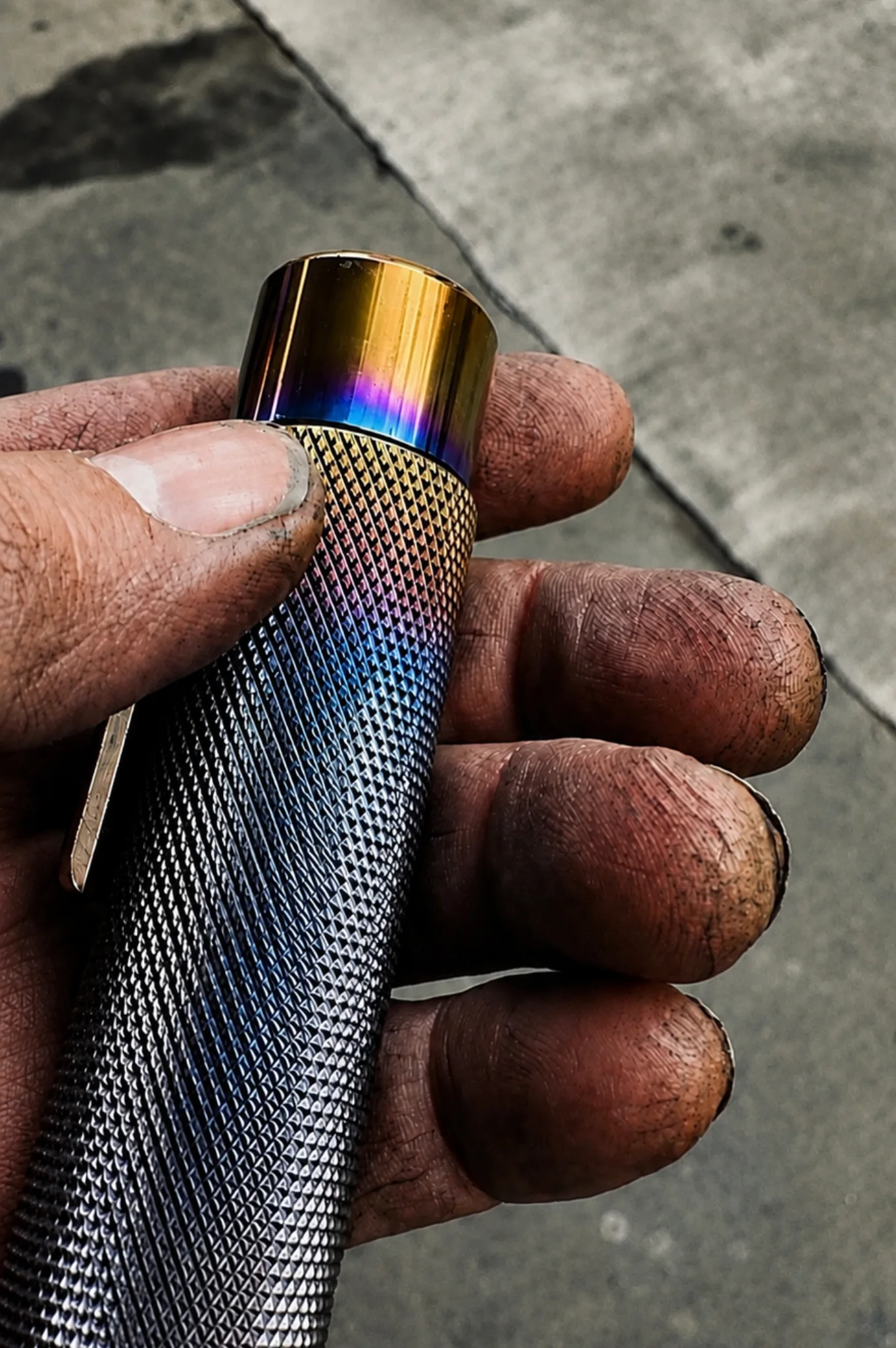
Stainless steel doesn’t have to stay silver.
One of the coolest characteristics of stainless steel is what happens to its surface when you carefully introduce heat. With controlled torch work, the natural silver finish can begin transforming through gold, bronze, reddish tones, purple, blue and deep blue.
That makes the Næxon Stainless Steel Tungsten Holder more than a practical way to carry and protect tungsten electrodes. Because of its stainless-steel construction, you can leave the holder in its original finish or customize its appearance by carefully manipulating heat.
Available in 4-inch and 7-inch sizes, it gives welders another opportunity to put their own personality into a tool they carry every day.
The basic idea is simple:
Heat + time + oxygen + stainless steel = color.
But controlling that color is where things get interesting.
Why Does Stainless Steel Change Color When Heated?
When stainless steel is heated in air, the oxide layer naturally present on its surface begins becoming thicker.
That microscopic change affects how light reflects from the surface. Instead of remaining silver, the stainless begins displaying different colors depending on the thickness of that oxide layer.
This phenomenon is commonly called heat tint or temper coloring.
You’re not actually adding gold, blue or purple pigment to the stainless.
You’re manipulating its surface with heat.
The resulting color depends on several variables, including the amount of heat, how quickly that heat is introduced, how long the stainless remains hot, the condition of the surface and the amount of oxygen available.
This is exactly why two people can take identical stainless pieces, use different torch techniques and end up with completely different finishes.
For welders who appreciate tools made specifically for industrial work, explore more of the Næxon product lineup and industrial gear.
Think of the Torch as Your Paintbrush
When heat-coloring a stainless tungsten holder, think of the torch as your paintbrush.
You’re controlling the appearance with flame movement, heat intensity, distance and time.
A MAP-Pro/MAPP-style gas torch can provide a relatively manageable way to introduce localized heat. An oxy-acetylene torch can deliver substantially more concentrated heat, which means the color transitions can happen much faster.
That’s important.
If you’re trying to produce gold and dump too much concentrated heat into the stainless, you may fly straight through the lighter colors and begin developing darker bronze, purple or blue before you realize it.
The goal isn’t simply to make the stainless extremely hot.
The goal is to control how it gets hot.
Understanding the Stainless Heat-Color Progression
As stainless begins heating and oxidizing, you’ll normally notice lighter colors first.
The progression can generally move through shades resembling:
Light straw → Gold → Bronze/Brown → Reddish-Purple → Purple → Blue → Dark Blue
The exact appearance can vary significantly.
A commonly referenced progression for 304 stainless heated in air places pale yellow around 554°F, straw yellow around 644°F, darker yellow around 698°F, brown around 734°F, purple-brown around 788°F, dark purple around 842°F, blue around 1,004°F and dark blue around 1,112°F.
Those numbers are useful for understanding the science, but they should not be treated as exact recipes for coloring your tungsten holder.
Time matters.
Surface finish matters.
Torch movement matters.
The stainless alloy matters.
Even the lighting you’re standing under can change how the finished color appears.
That means experienced torch control can be more useful than trying to chase one exact temperature.
Getting a Gold Finish
Gold is one of the first dramatic colors you’ll notice.
If gold is your target, don’t attack the holder with maximum heat.
Introduce heat gradually while keeping the torch moving.
Watch the surface closely.
You’ll begin seeing the original silver stainless develop lighter straw coloration. Continue carefully and the surface begins taking on richer gold tones.
Once you’ve reached the gold you’re looking for, remove the heat.
Remember that the metal itself is already storing thermal energy. Even after you move the flame away, the surface may continue changing slightly.
This is why slower, more controlled heating can make lighter colors easier to achieve.
Getting Bronze and Reddish Colors
Continue beyond gold and things become even more interesting.
The stainless can begin developing bronze, brown, copper-like and reddish-purple tones.
Don’t expect a bright automotive-paint red. What you’re seeing is an optical effect created by oxidation, so the appearance can change depending on lighting and viewing angle.
This transition area can produce some of the most unique-looking tungsten holders because multiple colors can exist simultaneously.
You might have gold on one section, bronze beside it and reddish-purple beginning farther down the holder.
That’s not necessarily a mistake.
It can become part of the design.
Getting Purple
Continue applying controlled heat and you’ll eventually begin entering the purple range.
Purple can be especially vibrant when surrounded by gold and blue transitions.
But this is also where paying attention becomes critical.
If you’re looking for purple and continue aggressively heating the same location, you’ll eventually push that area toward blue.
When the color you want appears, stop chasing it.
One of the biggest mistakes when heat-coloring stainless is thinking:
“Just a little more heat.”
Sometimes that little bit is enough to completely change the color.
Getting Blue
Blue generally develops after the purple range as oxidation progresses.
This can produce one of the most recognizable torch-colored stainless finishes.
Depending on your technique, you might create bright blue, dark blue or combinations of blue surrounded by purple and bronze.
Again, hotter doesn’t automatically mean better.
If you continue aggressively heating the stainless after reaching the blue you’re looking for, you can eventually lose some of the vibrant appearance and create a duller, heavily oxidized surface.
The skill is knowing when to quit.
For more welding-related equipment and protective gear, you can also explore the Næxon Resources section, where we cover welding, fabrication, industrial work and the equipment used by skilled tradespeople.
Torch Speed Changes Everything
This is one of the most important parts of the entire process.
How fast you move your torch changes the result.
Imagine making a very slow pass across one section of the tungsten holder.
That area has more time to absorb energy.
Now make the same pass considerably faster.
You’re using the same torch and potentially the same flame setting, but the stainless doesn’t experience the same thermal cycle.
That’s why heat coloring isn’t as simple as saying:
Gold = one temperature. Purple = another temperature. Blue = another temperature.
Temperature is only part of the equation.
Time at temperature matters.
Your travel speed matters.
Your distance from the metal matters.
Your flame concentration matters.
With practice, you begin manipulating all of those variables simultaneously.
MAPP/MAP-Pro vs. Oxy-Acetylene
Both can introduce enough heat to create stainless heat tint, but they behave differently.
A handheld MAP-Pro/MAPP-style torch can make it easier to gradually introduce heat when you’re experimenting with color.
An oxy-acetylene torch is capable of putting much more concentrated heat into a small area.
That can make it extremely responsive.
It can also make it extremely easy to overshoot.
If you’re using oxy-acetylene, especially with a concentrated flame, the color can progress quickly.
Gold can become bronze.
Bronze can become purple.
Purple can become blue.
And blue can move beyond the vibrant appearance you wanted.
Torch control matters more than raw heat.
Surface Preparation Matters
Before applying heat, start with a clean tungsten holder.
Oil, grease, fingerprints and other surface contamination can affect the appearance of the finished heat tint.
Clean stainless gives you a more consistent starting point.
Surface texture can also influence how the colors appear because polished stainless reflects light differently than heavily brushed or rough stainless.
After cleaning, avoid unnecessarily handling the area you’re planning to heat.
You’re essentially preparing a canvas.
The cleaner and more consistent that canvas is, the easier it becomes to understand what your torch technique is doing.
How to Heat-Color Your Næxon Stainless Steel Tungsten Holder
Before starting, remove all tungsten electrodes and anything else stored inside the holder.
Never apply torch heat while holding the tungsten holder in your hand.
Secure the empty holder appropriately in a safe, noncombustible work area and make sure the holder cannot trap pressure while being heated.
Clean the stainless thoroughly and allow it to dry.
Begin applying heat conservatively.
Keep the flame moving instead of immediately concentrating maximum heat in one location.
Then watch the stainless.
The metal itself becomes your indicator.
When you see gold developing, you know the oxidation process is underway.
If gold is what you want, stop there.
Want bronze?
Carefully continue.
Want purple?
Continue watching the transition.
Want blue?
Keep progressing carefully until the desired blue develops.
Once you’ve reached your target appearance, remove the flame and allow the holder to cool naturally on a suitable noncombustible surface.
Don’t assume the holder is safe to touch because the visible flame is gone. Stainless can remain dangerously hot while appearing completely normal.
If you’re working around welding and other hot-work environments regularly, it’s also worth understanding the role of proper protective clothing. Read Næxon’s guide on what every welder should know about flame-resistant apparel.
Create a Gold-to-Blue Gradient
You don’t have to make the entire holder one color.
In fact, some of the best-looking results come from intentionally creating a gradient.
Imagine:
Gold → Bronze → Reddish Purple → Purple → Blue
You can manipulate the amount of heat applied along different portions of the holder.
Areas receiving less heat remain in the lighter color range.
Areas receiving progressively greater heat move farther through the oxidation sequence.
Rotate the holder as you work if you want the coloration to develop around the circumference rather than only along one side.
This is where the process becomes less about simply heating stainless and more about controlling heat intentionally.
Every Holder Can Come Out Different
That’s one of the best parts.
Two Næxon tungsten holders don’t necessarily have to look identical after torch coloring.
Your flame.
Your speed.
Your distance.
Your heat.
Your stopping point.
Your color preference.
One person might stop at gold.
Another might want deep blue.
Someone else might create a gold-purple-blue gradient running the entire length.
You’re using heat to create your own finish.
An Important Difference Between Decorative Heat Coloring and Industrial Stainless
There’s an important distinction worth making.
Heat tint is oxidation.
On corrosion-critical stainless piping, sanitary tubing, process equipment and certain welded stainless components, heavy heat tint may be undesirable and may require proper post-weld cleaning or surface restoration.
A decorative stainless accessory isn’t the same thing as process piping carrying corrosive chemicals.
Don’t take the idea of deliberately creating heat tint on a tungsten holder and assume heat tint should simply be left untouched on every stainless welding application.
Different applications have completely different requirements.
That’s one of the reasons understanding materials matters just as much as understanding welding.
For broader information about the equipment and protective gear used across industrial trades, see The Ultimate Guide to Industrial Workwear.
Næxon Stainless Steel Tungsten Holder — 4” and 7”
This video is temporarily unavailable.
A tungsten holder is a simple tool, but simple tools are often the ones welders use every single day.
The Næxon Stainless Steel Tungsten Holder is built to provide a durable place to organize, carry and protect your tungsten electrodes while giving you the solid feel of stainless-steel construction.
And you’ve got two sizes.
4-inch for a more compact setup.
7-inch when you want the longer holder.
Leave yours in its original clean stainless finish—or turn the surface into something completely different.
Gold.
Bronze.
Reddish-purple.
Purple.
Blue.
Or create your own combination.
That’s part of the appeal of stainless.
Næxon builds the holder. You decide what it eventually looks like.
Shop the Næxon Stainless Steel Tungsten Holder on Amazon
Available in 4-inch and 7-inch sizes.
Safety: Torch work involves open flame, extremely hot metal and fire hazards. Use appropriate PPE, ventilation and a noncombustible work area, and follow the instructions supplied by the torch and fuel manufacturer. The holder must be empty before heating and should never be heated in a condition that could trap pressure.