If you’ve spent any time in a refinery, fabrication shop, power plant, chemical plant, construction site, or industrial facility, you’ve probably seen Z87 stamped somewhere on a pair of safety glasses.
Most workers know the basic idea:
Z87 means safety glasses.
But that’s only the beginning.
What does the marking actually mean? Is Z87 the same as Z87+? Does it mean the lenses can’t break? Does it automatically mean the glasses are approved for grinding? What about side protection, prescription lenses, tinted lenses, or polarized safety sunglasses?
These are important distinctions because safety glasses aren’t simply regular sunglasses with a Z87 stamp added to them.
The marking relates to an established eye-and-face protection standard used throughout American workplaces.
For anyone working around flying particles, tools, equipment, sparks, dust, debris, or other industrial hazards, understanding what you’re actually wearing is worth a few minutes.
What Does Z87 Mean?
The term Z87 comes from ANSI/ISEA Z87.1, the American National Standard for Occupational and Educational Personal Eye and Face Protection Devices.
The standard establishes requirements for different types of eye and face protection.
That includes protection intended for hazards involving things such as impact, optical radiation, droplets and splash, dust, and fine dust.
The standard also establishes testing, marking, selection, and other requirements for compliant protective devices.
So when you see Z87-related markings on legitimate safety eyewear, you’re looking at markings associated with a recognized safety standard—not simply a manufacturer’s marketing term.
What Is ANSI?
ANSI stands for the American National Standards Institute.
One common misunderstanding is that ANSI itself manufactures or individually approves every pair of safety glasses.
It doesn’t.
ANSI coordinates the development of voluntary consensus standards in the United States.
For occupational eye and face protection, the Z87.1 standard is developed through the standards process and published by the International Safety Equipment Association.
OSHA regulations also incorporate recognized eye and face protection standards into workplace requirements.
That’s why Z87.1 terminology appears constantly across American industrial jobsites.
Z87 and Z87+ Are Not the Same Marking
This is one of the most important things workers should understand.
Z87 and Z87+ should not automatically be treated as identical.
Under the Z87.1 marking system, the ”+” designation is associated with high-impact protection.
That little plus sign matters.
Workers sometimes see “Z87” somewhere on a product and immediately assume that it represents the highest level of impact protection available under the standard.
That’s not a safe assumption.
When impact hazards are part of the job, you need eye protection appropriate for that hazard and compliant with the employer’s PPE requirements.
Read the actual markings.
Don’t just look for the letters Z and the number 87.
What Does High Impact Mean?
Industrial eye hazards aren’t theoretical.
Think about what can happen during a normal shift.
A fragment can come off material.
A piece of scale can break loose.
A tool can slip.
Grinding can throw particles at high speed.
Compressed operations can move debris.
Cutting and fabrication can produce fragments.
Equipment can kick material toward a worker’s face.
The high-impact provisions of the Z87.1 standard are designed around testing protective devices against specified impact conditions.
The “+” marking therefore communicates meaningful information about the protector’s tested impact classification.
It isn’t decoration.
Does Z87+ Mean the Glasses Are Unbreakable?
No.
This is one of the biggest misconceptions about safety eyewear.
Safety glasses are not indestructible.
A compliant protector is designed and tested for specified hazards and conditions.
That doesn’t mean nothing can ever penetrate, crack, damage, dislodge, or overwhelm it.
Every piece of PPE has limitations.
The same principle applies to hard hats, gloves, FR clothing, harnesses, welding hoods, respirators, and safety footwear.
PPE reduces risk.
It doesn’t make the worker invincible.
Why Regular Sunglasses Aren’t Automatically Safety Glasses
This is particularly important for workers who spend most of the day outdoors.
Regular sunglasses can look almost identical to safety sunglasses.
Some may even have thick lenses and durable frames.
That doesn’t automatically make them occupational safety eyewear.
A regular pair of fashion sunglasses may provide UV protection and glare reduction without being designed or tested to meet the applicable Z87.1 requirements.
That distinction matters on an industrial site.
Your eyes don’t care whether the glasses cost $20 or $300.
If occupational impact protection is required, you need the appropriate safety eyewear.
Polarized Does Not Mean Safety Rated
This creates another common misunderstanding.
Polarized describes an optical feature.
Polarized lenses are designed to reduce certain reflected glare.
That can be extremely useful for workers outdoors around pavement, vehicles, equipment, water, metal surfaces, and bright sunlight.
But polarization by itself says nothing about whether the eyewear meets an occupational impact-protection standard.
A pair of sunglasses can be polarized without being Z87 safety eyewear.
Likewise, safety eyewear can incorporate polarized lenses when the product is properly designed, tested, and marked for its intended safety classification.
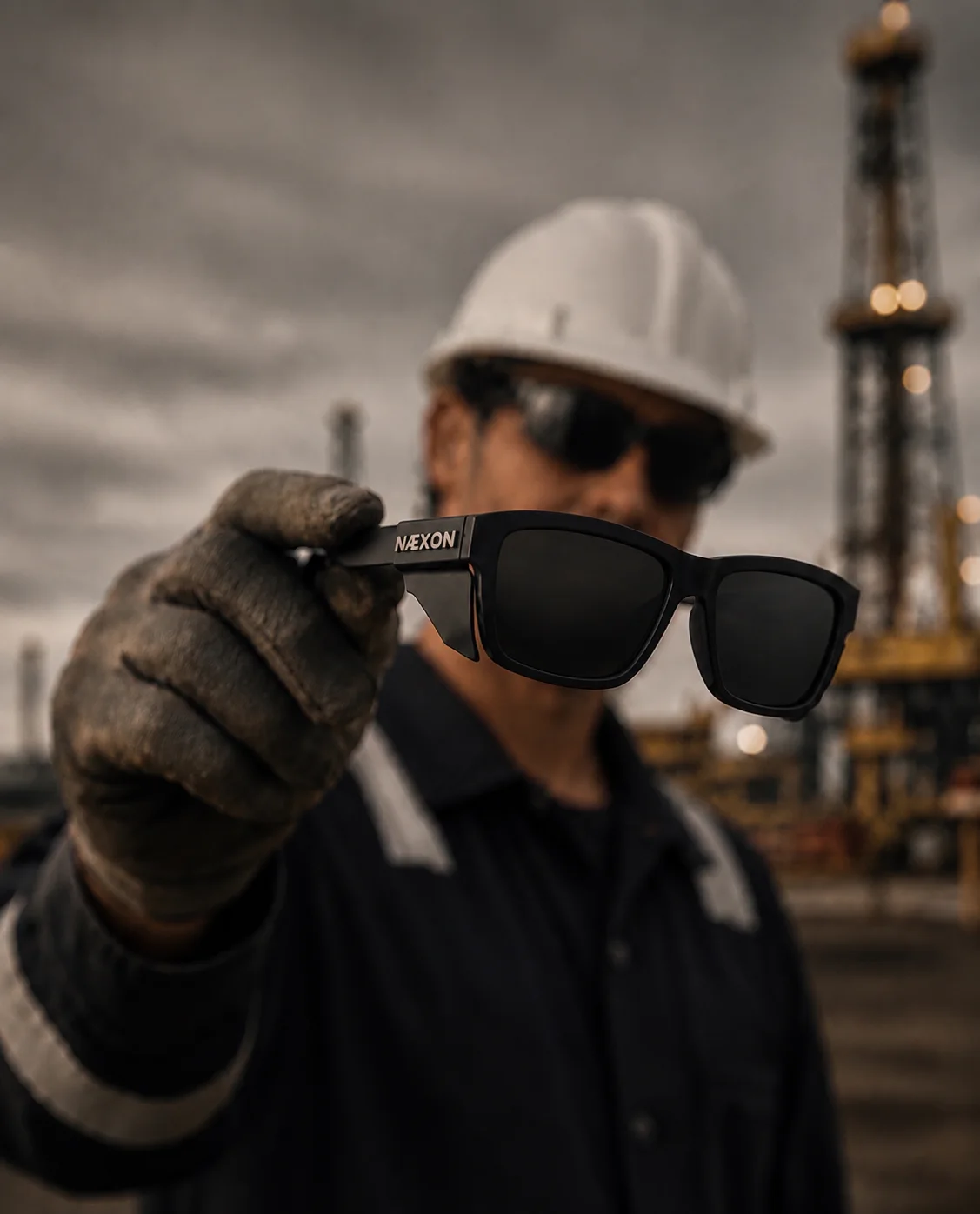
For industrial workers who want both glare reduction and occupational eye protection, this is why products such as Næxon Badger safety sunglasses are intended to combine work-focused protective eyewear with the features workers want from everyday sunglasses.
Always verify the exact markings and specifications of the particular model being used.
UV Protection and Impact Protection Are Different Things
Another mistake is assuming that UV protection and impact protection mean the same thing.
They don’t.
UV protection concerns ultraviolet radiation reaching the eyes.
Impact protection concerns physical objects or particles striking the eyewear.
A lens can potentially provide excellent UV protection without qualifying as occupational impact protection.
That’s why “100% UV protection” shouldn’t be interpreted as:
These are automatically safety glasses.
For industrial work, evaluate both the optical protection you need and the physical hazards present.
What About Side Protection?
A hazard doesn’t always come directly toward the center of your face.
Particles can approach from the side.
That’s why lateral protection can matter.
Depending on the design, safety eyewear may provide side protection through integral side coverage or separate side shields.
OSHA requires employees exposed to flying objects to use eye protection that provides side protection.
This is particularly relevant for industrial workers surrounded by other trades.
You may not be the person creating the hazard.
Someone working several feet away may be.
Your Coworker’s Work Can Become Your Eye Hazard
This is one reason safety glasses are commonly required throughout entire industrial work areas.
Maybe you’re a pipefitter doing layout.
You’re not grinding.
But someone nearby is.
Maybe you’re an operator walking through a unit.
You’re not cutting anything.
But maintenance work is occurring around you.
Maybe you’re a carpenter checking dimensions.
You’re not using a grinder.
But another crew is performing work nearby.
Eye protection isn’t only about what you are doing.
It’s also about what is happening around you.
Do Z87 Safety Glasses Protect Against Grinding?
This requires more nuance than simply answering yes.
Grinding can create significant flying-particle hazards.
Appropriate impact-rated safety glasses may form part of the required eye-protection system.
However, the hazard assessment may require additional face protection, such as a face shield, depending on the task.
A face shield also should not automatically be treated as a replacement for required safety glasses or goggles underneath it.
The exact combination depends on the hazard and employer requirements.
This is why “I’m wearing Z87 glasses” doesn’t automatically mean you’re properly protected for every task performed on an industrial site.
Safety Glasses vs. Goggles
Safety glasses are excellent for many common workplace hazards.
But some hazards require a different level or type of protection.
Chemical splash is a good example.
A pair of open safety glasses is not automatically equivalent to properly selected chemical-splash goggles.
Fine dust can create another situation where more complete enclosure may be necessary.
The Z87.1 system includes markings and classifications addressing different types of hazards.
The important lesson is simple:
Use the protector designed for the hazard.
Don’t assume one pair of safety glasses handles everything.
Safety Glasses vs. Face Shields
A face shield protects a much larger portion of the face.
That can be necessary during tasks involving substantial flying particles, splash, or other hazards.
But workers sometimes make the opposite mistake and think:
I’m wearing a face shield, so I don’t need safety glasses.
Depending on the hazard and employer requirements, primary eye protection may still be required underneath the face shield.
Think of PPE as layers selected for the exposure rather than interchangeable pieces.
What About Welding?
Welding introduces another category of eye hazard: optical radiation.
A normal pair of clear Z87 safety glasses does not replace a properly selected welding lens or welding helmet for arc welding.
Welding protection involves appropriate filter shades and equipment selected for the operation.
Safety glasses may still be worn underneath a welding hood as required by the employer or site.
But don’t confuse general impact protection with welding filter protection.
They solve different problems.
What About Prescription Safety Glasses?
Workers who require corrective lenses still need appropriate protection.
OSHA requires eye protection for employees who wear prescription lenses to either incorporate the prescription into the protective eyewear or be worn over the prescription lenses without disturbing their position or proper fit.
Regular prescription glasses aren’t automatically safety glasses.
This is why prescription safety eyewear exists.
Workers shouldn’t have to choose between seeing clearly and protecting their eyes.
The Markings Tell a Story
Safety-eyewear markings can communicate more than workers realize.
Depending on the protector and applicable version of the standard, markings can identify the manufacturer, impact classification, optical radiation protection, splash/droplet protection, dust protection, and other characteristics.
You don’t necessarily need to memorize every possible code.
But every industrial worker should develop one habit:
Look at the markings.
Don’t assume.
Don’t Trust Appearance Alone
Modern safety glasses have changed dramatically.
Some look like traditional shop glasses.
Others look like sports eyewear.
Some look almost exactly like premium sunglasses.
That’s a good thing.
Workers are more likely to consistently wear protective eyewear that fits comfortably and looks good.
But appearance can’t tell you whether eyewear meets a safety standard.
Two pairs of black polarized sunglasses sitting next to each other might look nearly identical.
One may be properly marked occupational safety eyewear.
The other may simply be fashion sunglasses.
Turn them over.
Check the markings.
When Should Safety Glasses Be Replaced?
Safety glasses don’t necessarily become useless after a predetermined number of days.
Condition matters.
Inspect them.
Deep scratches can interfere with vision.
Damaged frames can affect fit.
Loose components can prevent the eyewear from staying properly positioned.
Chemical exposure or severe contamination may also affect whether a protector should remain in service.
And if eyewear has experienced a significant impact, follow the manufacturer’s and employer’s requirements regarding inspection or replacement.
Safety glasses are relatively inexpensive compared with the value of your eyesight.
Don’t try to get another six months out of a destroyed pair just to save a few dollars.
Scratched Lenses Are More Than an Appearance Problem
Industrial workers are rough on glasses.
They get thrown into gang boxes.
Placed on dashboards.
Dropped onto concrete.
Covered in dust.
Wiped with dirty shirt sleeves.
Eventually the lenses can become heavily scratched.
Even if a scratch doesn’t immediately eliminate the protective characteristics of the eyewear, poor visibility creates another problem.
If you can’t clearly see your work, you’re introducing additional risk.
Replace badly damaged eyewear.
Comfort Matters More Than People Think
The best safety glasses in the world can’t protect your eyes while they’re sitting on top of your hard hat.
Workers remove uncomfortable PPE.
That’s reality.
Safety eyewear should fit securely without creating unnecessary pressure around the nose, ears, or temples.
For outdoor workers, glare reduction and UV protection can also make long shifts more comfortable.
This is why industrial safety eyewear increasingly combines protection with the comfort and appearance of everyday sunglasses.
Workers shouldn’t have to choose between something they want to wear and something appropriate for the job.
Why Næxon Badger Safety Sunglasses Fit Into This Conversation
The idea behind Næxon Badger safety sunglasses is straightforward:
Industrial workers shouldn’t have to switch between work eyewear and everyday-looking sunglasses simply because they step outside.
For workers spending long shifts around refineries, pipelines, fabrication shops, construction sites, heavy equipment, and outdoor industrial environments, safety eyewear should be comfortable enough that wearing it becomes automatic.
But regardless of brand, workers should always verify that the specific eyewear they’re using carries the markings and specifications required for their job.
The name on the frame isn’t what protects you.
The correct product, correct rating, correct fit, and correct use do.
Z87 Is More Than a Stamp
That tiny marking on your safety glasses represents something much larger.
It tells you that occupational eye protection isn’t based on whether a pair of glasses looks strong.
There are standards.
There are tests.
There are classifications.
There are different hazards.
And there are limitations.
The most important distinction for many industrial workers is understanding that Z87 and Z87+ aren’t simply two ways of writing the same thing, and that polarization, UV protection, impact protection, splash protection, and welding protection are separate characteristics that shouldn’t be confused with one another.
The next time you grab your safety glasses before walking through the gate, take five seconds and look at them.
Find the markings.
Know what you’re wearing.
Know what they’re designed to protect you from.
And most importantly, know what they’re not designed to protect you from.
Because safety glasses may be one of the smallest pieces of PPE you carry onto the jobsite, but they’re protecting something you don’t get a spare set of:
your eyes.
